
5000 years of chance
Discover the fascinating history of games of chance: from ancient Greek knucklebones to modern algorithms. Coin flip, dice, roulette and more.
From ancient Greek knucklebones to smartphone algorithms
Since the dawn of humanity, chance has held an irresistible fascination. Long before inventing writing, our ancestors were already trying to "capture" the unpredictable: to settle a dispute, consult the gods, or simply to have fun. From this universal need was born a lineage of ingenious objects — the bone, the die, the card, the wheel — that runs through every civilization.
This is more than a collection of anecdotes. It tells the story of our relationship with fate and uncertainty: sometimes humans saw in the draw the voice of the gods, sometimes pure amusement, sometimes a mathematical problem to be tamed. The very same object — a sheep's knucklebone — served at once as a child's toy, a divination tool, and the ancestor of the modern die.
From the shepherds of the Near East to the quantum generators in our phones, every randomization tool you use today carries millennia of history. Let's set off on this journey, era by era.
~5000 BCE – 5th century
Antiquity: the bone before the die
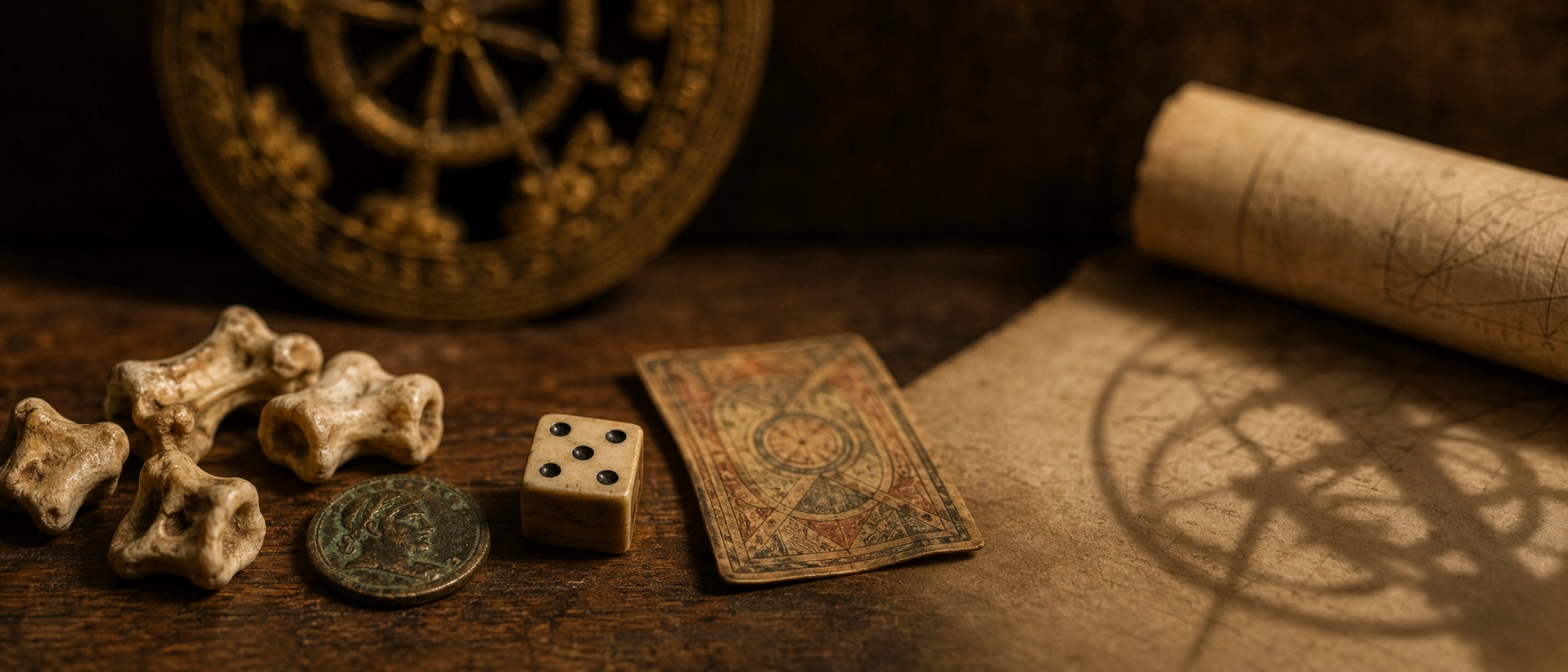
The oldest known "dice" were not cubes, but bones. The astragalus — an anklebone of a sheep or goat — appears in large numbers at archaeological sites from around 5000 BCE. Its irregular shape lets it land on only four faces, with unequal odds (about 38% for the broad side, 12% for the narrow one): unknowingly, it was humanity's first object of chance. [1]
In Mesopotamia, chance entered games very early. The Royal Game of Ur, one example of which (held at the British Museum) dates to roughly 2600–2400 BCE, ranks among the oldest board games in the world. Players advanced their pieces according to the throw of four-sided (tetrahedral) dice. Unearthed by archaeologist Leonard Woolley between 1922 and 1934, its rules were only rediscovered in the 1980s, when curator Irving Finkel translated a Babylonian tablet. [2]
Among the Greeks and Romans, these bones — the tali — were everywhere: children's games, adults' bets, and above all divination. People threw the astragali and consulted tables assigning a meaning to each combination. The game was so widespread that Plato and Herodotus already debated its origin. Chance was not yet a calculation: it was a language through which people believed they could read the will of the gods. [1]
Astragali (knucklebones)
Near-Eastern shepherds used sheep heel bones for divination and the earliest games of chance.
Royal Game of Ur
The oldest known board game, played in Mesopotamia with wooden tetrahedral dice.
Egyptian Senet
A game found in Tutankhamun's tomb, mixing strategy with the random throw of casting sticks.
Basilinda in Ancient Greece
An ancestor of Truth or Dare: a "king" was chosen by drawing lots and imposed challenges on guests.
"Alea iacta est"
Julius Caesar crossed the Rubicon with these famous Latin words: "the die is cast."
9th – 15th century
The Middle Ages: the arrival of cards
While dice and knucklebones had already crossed the centuries, a new object of chance appeared: the playing card. Its cradle is China, which gave the world paper, printing and, with them, the first cards. From there the game spread to India and Persia. [3]
It was through Mamluk Egypt that cards then reached the Mediterranean. Mamluk decks already featured four "suits" (cups, coins, swords, polo-sticks) and court cards — a structure our modern decks inherit directly. [3]
Then, "as if out of a void," cards appear in Europe with striking suddenness: between 1370 and 1380, mentions multiply almost simultaneously in Italy, Spain, Germany, Belgium and Switzerland — often in municipal bans on playing. Parlour chance had arrived, and was already being regulated. [3]
Birth of the word "hazard"
From the Arabic az-zahr ("the die"), the word reached Europe via Moorish Spain and the Crusades.
Playing cards in China
Invented during the Tang dynasty, the first cards reached Europe around 1370 via the Silk Road.
17th – 19th century
The modern era: when chance became a science
The decisive turning point was not a new object, but an idea. In 1654, a gambler, the Chevalier de Méré, put an old puzzle to Blaise Pascal: how should the stakes of an interrupted game be divided fairly? This was the "problem of points." From the correspondence between Pascal and Pierre de Fermat came the first true analysis of chance, and the notion of expected value (the weighted average of possible outcomes). Probability theory had just been born — out of a gambling problem. [5]
Chance then went mechanical. While trying to build a perpetual-motion machine in the 17th century, Blaise Pascal devised a wheel that, diverted from its purpose, would become the roulette. Its modern form took shape in 18th-century France, and the single-zero version, launched in Monte Carlo by the Blanc family in the 19th century, conquered Europe. [4]
The 19th century finally mechanized pocket-sized chance. Around 1894, in San Francisco, mechanic Charles Fey invented the first modern slot machine, the Liberty Bell: three reels, symbols (horseshoe, heart, bell…) and an automatic payout. Its three-reel model is still the basis of today's machines. [6]
Cardano theorizes games of chance
The Italian mathematician Cardano wrote the first known treatise on probability: Liber de Ludo Aleae.
Pascal and Fermat found probability theory
Their correspondence over a betting problem from the Chevalier de Méré founded modern probability theory.
Liberty Bell: the first slot machine
Charles Fey invented the first three-reel mechanical slot machine in San Francisco.
20th century – today
The digital era: manufacturing the unpredictable
A paradox: the computer, a logical and predictable machine by design, cannot produce true randomness on its own. It simulates randomness with pseudo-random generators (PRNGs), algorithms such as the Mersenne Twister. Highly effective, they nonetheless have two limits: they start from a "seed" (anyone who knows the seed can reproduce the sequence) and eventually repeat. [8]
To obtain genuine unpredictability, we therefore look for it in the physical world. The most famous example: Cloudflare, which films a wall of about a hundred lava lamps in its San Francisco lobby; the never-identical flow of the images serves as a source of entropy to generate encryption keys. Its other offices do the same differently — a double pendulum in London, the decay of a pellet of uranium in Singapore. [7]
The ultimate frontier: quantum randomness. At the Australian National University (ANU), "truly" random numbers are generated by measuring vacuum fluctuations with lasers — a randomness that quantum physics holds to be fundamentally unpredictable, whereas two identical pseudo-random generators would produce the same sequence. [8]
ENIAC and the Monte Carlo method
Von Neumann and Ulam used computer-generated randomness to simulate nuclear explosions.
Quantum randomness and lava lamps
Cloudflare protects 10% of the internet with a wall of lava lamps; IBM uses quantum noise for "true" randomness.

Truth or Dare
Truth or Dare is one of the most universal and timeless party games. Its origins trace back to ancient Greece, where a similar game called "Basilinda" (the King's Game) was played during symposiums. A designated "king" could ask embarrassing questions or impose forfeits on guests. During the Middle Ages, the concept evolved into "Questions and Commands," a popular entertainment in European courts. Aristocrats enjoyed asking compromising questions or imposing challenges during banquets and celebrations. The game appears in Renaissance writings in various forms. The modern version of the game was codified in America in the early 20th century. The simple rules — choose between honestly answering a personal question or completing a dare — naturally became a staple at parties for teenagers and young adults. The 1950s-1960s saw the game become an essential part of slumber parties and birthday celebrations. It became a social rite of passage, a playful way to break the ice and get to know each other in a safe environment. With the digital era, Truth or Dare experienced a spectacular revival. Mobile apps and online versions offered hundreds of categorized questions, from classic to playful, making the game accessible anytime, anywhere. Today, the game remains a pillar of social interaction worldwide. It is played in every culture under different names: "Action ou Vérité" in French, "Verdad o Reto" in Spanish, "Wahrheit oder Pflicht" in German. Its popularity on social media, with millions of TikTok and YouTube videos, proves this classic has lost none of its appeal.
💡 Did you know?
- Truth or Dare has existed for over 2,000 years in various cultural forms around the world.
- In the US, more than 80% of teenagers have played Truth or Dare at least once during a sleepover.
- The #TruthOrDare hashtag has generated over 15 billion views on TikTok, making it one of the most viral games.
- In the medieval version, dares could include physical trials like jumping into a frozen lake!
- The game is used by some psychologists as a therapeutic tool to improve group communication.
- There are official versions of the game for kids, teenagers, couples, and even a corporate version for team building.

Amidakuji
Amidakuji (あみだくじ) traces its origins to medieval Japan during the Muromachi period (1336-1573). The earliest written records appear in documents from the Ashikaga shogun's court, where officials used diagrams with radiating lines to fairly distribute land parcels among peasants. The name "Amidakuji" comes from the Buddha Amida (Amitabha in Sanskrit), revered in Pure Land Buddhism (Jodo-shu, founded by Honen in 1175): the original drawing, with its lines radiating from a central point, evoked the luminous halo (kouhai) behind the golden statues of this Buddha at the Byodo-in temple in Uji, designated a national treasure in 1053. During the Edo period (1603-1868), the game evolved into its current form of parallel vertical lines connected by horizontal bridges. Merchants in Osaka adopted it to assign stalls at the Naniwa markets, and the Tenpo Suikoden (1829) mentions its use in the Yoshiwara pleasure quarters to determine the order of clients. Samurai used it during ceremonies to settle matters of etiquette without losing face, in accordance with the Confucian principle of wa (harmony). The mathematician Seki Takakazu (1642-1708), considered the "Japanese Newton," studied the combinatorial properties of similar configurations in his Hatsubi Sanpo (1674). In the 20th century, Amidakuji became widespread in the Japanese education system. The Ministry of Education (Monbukagakusho) recommended its use in elementary schools from the 1920s as a tool for teaching fairness and chance. Today, over 95% of Japanese schoolchildren know the game before the age of 10, according to a 2018 Benesse survey. Fourth-year elementary school mathematics textbooks use it to introduce the concepts of permutation and probability. In group theory, each Amidakuji diagram corresponds to a decomposition into adjacent transpositions of a permutation in the symmetric group S_n. Mathematician Takeuchi Yasuo demonstrated in 1994 that any permutation of n elements can be represented by an Amidakuji, and Matsui Tomomi proved in 1995 that the minimum number of bridges needed to achieve a given permutation corresponds exactly to its number of inversions. The connection with Coxeter diagrams and reduced words in the symmetric group was formalized by Eriksson and Linusson in 1996, making Amidakuji a subject of study in its own right in algebraic combinatorics. Social psychology sheds light on why Amidakuji is so effective as a consensus tool. The work of Thibaut and Walker (1975) on procedural justice shows that individuals more readily accept an unfavorable outcome when the process is perceived as fair. In Japan, where the concept of wa (group harmony) takes precedence over individual preferences according to anthropologist Nakane Chie (Japanese Society, 1967), Amidakuji offers a decision mechanism that preserves everyone's face. Yamagishi Toshio (Hokkaido University) showed in 2003 that Japanese people prefer visual and participatory drawing methods over anonymous digital draws, as process transparency strengthens mutual trust. Amidakuji is ubiquitous in contemporary Japanese culture. In manga, Gintama (Sorachi Hideaki, 2003) and Doraemon (Fujiko F. Fujio) dedicate entire episodes to it. Variety shows such as those featuring AKB48 use it live to assign roles and challenges before millions of viewers. In South Korea, the variant "sadari tagi" (사다리타기) is equally popular — the show Running Man (SBS, since 2010) has made it known across all of Asia. Mobile apps like Amidakuji Maker (over 500,000 downloads on Google Play in 2023) and built-in versions in LINE (230 million users) have digitized the practice for a new generation.
💡 Did you know?
- Amidakuji is used daily by over 95% of Japanese schoolchildren before age 10 to assign chores, choose seats, or designate a volunteer!
- In mathematics, each Amidakuji corresponds exactly to a permutation of the symmetric group — the minimum number of bridges needed equals the number of inversions of that permutation!
- The name comes from the Buddha Amida whose luminous halo at the Byodo-in temple in Uji (1053) resembled the original game design with its radiating lines!
- In South Korea, the variant "sadari tagi" is so popular that the show Running Man (SBS) made it known across all of Asia, and apps like LINE integrate it for its 230 million users!
- Mathematician Seki Takakazu, nicknamed the "Japanese Newton," was already studying the combinatorial properties of similar configurations in his Hatsubi Sanpo of 1674!
Bingo
Bingo descends directly from the Italian lottery "Il Gioco del Lotto d'Italia," established in Genoa in 1530 to replace clandestine bets placed on the city's senatorial elections. Five names were drawn at random from 90 candidates, and the Genoese wagered on the outcome — a mechanism the government decided to regulate by creating an official lottery. The idea proved so successful that King Charles III of Spain imported the model to Naples in 1734 under the name "Tombola." Every Saturday before Christmas, Neapolitan families gathered around the "panariello" (little basket) to draw the numbers — a tradition that endures to this day in southern Italy. In the 18th century the game crossed the Alps and was transformed along the way. In France it became "Le Lotto," favored by the Parisian aristocracy who played it in their salons. But it was in Germany that Bingo underwent its most original mutation: in 1850 educators adapted it as a teaching tool, creating variants featuring multiplication tables, verb conjugations, and world capitals, turning a game of chance into a genuine learning aid. The German educational Lotto, sold in wooden box sets, was exported across Europe and as far as the United States in the second half of the 19th century. Modern Bingo was born in 1929, when New York toy salesman Edwin S. Lowe discovered a game called "Beano" at a fairground in Jacksonville, Georgia. Players marked drawn numbers with dried beans on cardboard cards. Captivated by the crowd's excitement, Lowe reproduced the game back home in New York. According to legend, an overexcited player accidentally shouted "Bingo!" instead of "Beano!" — and the name stuck. Lowe commercialized the game under that name in 1930, commissioning mathematician Carl Leffler from Columbia University to design 6,000 cards with unique combinations. This titanic feat of combinatorics reportedly pushed Leffler to the edge of madness. The mathematics of Bingo reveal a surprising complexity. For a standard Bingo 75 card (a 5×5 grid with a free center space), there are exactly 111,007,923,832,370,565 possible card combinations — a figure derived from the arrangements of 15 numbers across each of the five B-I-N-G-O columns. Statistician Joseph E. Granville published "How to Win at Bingo" in 1977, proposing a strategy based on Tippett's law: the more numbers are drawn, the more they tend toward the mean (38 in Bingo 75, 45 in Bingo 90). Controversial as it was, the theory inspired generations of players. In 2009, Professor Andrew Percy of the University of Manchester calculated that an average of 41.1 numbers must be drawn before a player completes a line on a Bingo 75 card. Bingo became a massive social phenomenon in the 20th century, particularly in the United States and the United Kingdom. By 1934, more than 10,000 Bingo games were taking place every week across the US, many organized by Catholic parishes to raise funds — a suggestion originally made by a priest in Wilkes-Barre, Pennsylvania, which ultimately generated millions of dollars for the Church. In the UK, the Gaming Act of 1960 legalized commercial Bingo halls: by 1963 there were 1,500 "Bingo halls" attracting 14 million British players per week. The Mecca Bingo chain, founded in 1961, became a national institution. Sociological studies, such as Dixie Dean Chaplin's 1999 research, show that Bingo plays a crucial role in building social bonds, particularly for older women and working-class communities. Today, Bingo is experiencing a digital renaissance. The global online Bingo market is estimated at $2.4 billion in 2024 (Grand View Research), with annual growth of 9.3%. Platforms such as Tombola (over 5 million players across Europe) and Buzz Bingo are redefining the experience with chat rooms, progressive jackpots, and fast-paced variants. In Japan, Bingo remains a staple of end-of-year company parties (忘年会, bōnenkai). In Spain, Bingo is the second most popular gambling game after the national lottery, with more than 300 physical halls. The "Drag Queen Bingo" phenomenon, born in the gay bars of Seattle in the 1990s, has spread worldwide and helped reinvigorate the game's image for a younger generation.
💡 Did you know?
- Mathematician Carl Leffler designed 6,000 unique Bingo cards for Edwin Lowe in 1930 — a task so grueling that, according to legend, it drove him nearly mad!
- There are exactly 111,007,923,832,370,565 possible Bingo 75 card combinations — far more than the number of stars in the Milky Way (around 200 billion)!
- British Bingo has its own colorful slang: 88 is called "two fat ladies," 11 is "legs eleven," and 22 is "two little ducks"!
- By 1934 — just five years after Edwin Lowe launched the game — more than 10,000 Bingo games were held every week in the US, generating millions of dollars for Catholic parishes!
- The largest online Bingo jackpot ever won stands at £5.9 million (around €7 million), scooped by a British player on Tombola in 2012!

Fortune Cookie
Despite its name, the fortune cookie traces its roots not to China but to Japan. Tsujiura senbei (fortune crackers) were sold near Shinto shrines as early as the 19th century, particularly in Kyoto's Fushimi district. These crackers, larger and darker than modern fortune cookies, contained predictions written on slips of paper called omikuji. Researcher Yasuko Nakamachi of Kanagawa University found references to these biscuits in Japanese ukiyo-e woodblock prints dating back to 1878, proving the tradition was well established before any emigration to America. The Sohonke Hogyokudo bakery, founded in Kyoto in 1846, still claims to produce these handcrafted ancestors of the fortune cookie to this day. The arrival of the fortune cookie in the United States remains a heated debate among several families. Makoto Hagiwara, designer of the Japanese Tea Garden in San Francisco's Golden Gate Park, reportedly began serving fortune cookies around 1914, made by Suyeichi Okamura's Benkyodo bakery. Meanwhile, David Jung, founder of the Hong Kong Noodle Company in Los Angeles, claimed to have created them in 1918 to distribute uplifting messages to homeless people in the neighborhood. In 1983, the city of San Francisco officially ruled in Hagiwara's favor during a "Court of Historical Review," sparking outrage in Los Angeles. Federal Judge Daniel Collins delivered the symbolic ruling while biting into a fortune cookie right in the courtroom. World War II marked a decisive turning point. In 1942, President Roosevelt's Executive Order 9066 led to the internment of 120,000 Japanese Americans in detention camps. The Japanese bakeries that had been producing fortune cookies were abruptly shut down. Chinese-American restaurateurs, whose establishments were booming thanks to returning GIs' fascination with Asian cuisine, took over production. The cookie thus shifted from one culture to another without American customers ever noticing. Within less than a decade, the fortune cookie became an iconic fixture at the end of every meal in Chinese-American restaurants. The industrialization of the fortune cookie truly began in 1964, when Edward Louie of the Lotus Fortune Cookie Company in San Francisco developed the first automatic folding machine. Before that, each cookie was folded by hand using chopsticks. In 1973, Wonton Food Inc. was founded in Brooklyn by Tat Shing Wong, and quickly became the world's largest producer with 4.5 million cookies per day and nearly 200 employees. Former vice president Donald Lau wrote the majority of the fortune messages for over 30 years, crafting 4 to 5 new texts daily, before passing the torch in 2017, admitting he had "run out of inspiration." Today, over 3 billion fortune cookies are produced each year, nearly all of them in the United States. Fortune cookie messages exploit a well-documented cognitive bias: the Barnum effect, named after the famous showman P.T. Barnum. This phenomenon, studied by psychologist Bertram Forer in 1948 at the University of California, Los Angeles, describes our tendency to accept vague personality descriptions as perfectly tailored to us. Forer demonstrated that students rated an identical psychological profile — taken from a newspaper horoscope — at 4.26 out of 5 for accuracy. Fortune cookie messages work on exactly this principle: "An unexpected journey will bring you joy" always seems relevant. Psychologist Paul Meehl coined the term "P.T. Barnum acceptance" in 1956, and later studies showed that confirmation bias amplifies the effect — we remember the predictions that come true and forget the rest. The fortune cookie remains paradoxically unknown in mainland China. In 1992, Hong Kong-based Fancy Foods attempted to introduce them in Shanghai and Guangzhou under the slogan "a genuine American product," but the venture fizzled out. Writer Jennifer 8. Lee, in her book "The Fortune Cookie Chronicles" (2008), traveled to 40 Chinese cities without finding a single one. However, the cookie has gone global: it can be found in Brazil (biscoito da sorte), France, Japan (where it returned in its Americanized form), and even India. On March 30, 2005, a fortune cookie made history by "predicting" five of the six winning Powerball numbers: 110 people who had played those numbers each won between $100,000 and $500,000, triggering a lottery investigation that ultimately confirmed it was pure coincidence.
💡 Did you know?
- On March 30, 2005, a Wonton Food Inc. fortune cookie "predicted" 5 of the 6 Powerball numbers — 110 people pocketed between $100,000 and $500,000 each!
- Fortune cookies are completely unknown in mainland China: writer Jennifer 8. Lee visited 40 Chinese cities in 2008 without finding a single one.
- Wonton Food Inc., based in Brooklyn, produces 4.5 million fortune cookies per day — that is roughly 52 cookies per second, around the clock!
- Donald Lau, former vice president of Wonton Food, wrote fortune cookie messages for over 30 years before retiring in 2017, admitting he had "run out of inspiration."
- The largest fortune cookie ever made weighed 6 kg and measured over 60 cm: it was crafted in 2007 by Panda Express for a charity campaign.
Boggle Dice
Boggle is a word game invented by Allan Turoff in the 1970s. This American game designer had the brilliant idea of combining the randomness of dice with the richness of vocabulary, creating one of the world's most popular word games. The concept is simple yet addictive: 16 dice bearing letters are shaken in a special tray, forming a random 4×4 grid in which players must find as many words as possible within a time limit. The game was first marketed in 1972 by Parker Brothers, the famous American publisher already known for Monopoly and Clue. The success was immediate: Boggle combined the accessibility of a family game with the intellectual depth of a linguistic challenge. Unlike Scrabble, where players take turns placing letters, Boggle pits all players in simultaneous competition, creating palpable tension during the three-minute hourglass countdown. In 1984, Parker Brothers was acquired by Hasbro, which continued to develop the Boggle brand. Over the decades, many variants emerged: Big Boggle (5×5 grid with 25 dice), Super Big Boggle (6×6 grid), Boggle Junior for children, and Boggle Flash with electronic dice. Each version brought its own twist while preserving the essence of the original game. Boggle experienced a true renaissance in the digital age. Apps like Scramble with Friends (later renamed Boggle with Friends) allowed millions of players to compete online. The game also became a popular tool in language education, helping students build their vocabulary in an engaging way. Studies have shown that regular Boggle practice improves word recognition abilities and linguistic fluency. Boggle competitions have existed since the 1980s and continue to attract enthusiasts from around the world. Official tournaments organized by Hasbro bring together players capable of finding over 100 words in just three minutes, thanks to advanced grid-scanning techniques. The best players develop sophisticated strategies, memorizing common prefixes and suffixes to spot words more quickly. Today, Boggle remains one of the best-selling word games in the world, alongside Scrabble and Bananagrams. Its fundamental concept has not changed since 1972: shake the dice, flip the hourglass, and frantically search for words in the grid. It is this simplicity, combined with infinite strategic depth, that makes Boggle a timeless classic.
💡 Did you know?
- The world record for words found in a single standard Boggle game (3 minutes) exceeds 150 words, achieved by professional players during official competitions.
- The name "Boggle" reportedly comes from the English verb "to boggle," meaning "to be amazed" or "to hesitate," perfectly reflecting players' reactions when facing the letter grid.
- The letter distribution on Boggle dice is not random: it is carefully calibrated to maximize the number of possible words in each game, with higher frequencies of vowels and common consonants.
- Boggle is used in some universities as an educational tool for foreign language learning, as it simultaneously stimulates visual recognition, vocabulary, and language processing speed.

Price Order
Estimating and ranking items by value are skills as old as trade itself. In Sumerian Mesopotamia, around 3000 BC, clay tablets from Uruk already listed prices for barley, copper, and livestock, enabling merchants to compare relative values. In ancient Greece, Aristotle distinguished between "use value" and "exchange value" in the Nicomachean Ethics (c. 350 BC), laying the groundwork for thinking about price hierarchies. Roman merchants relied on Diocletian's Edict on Maximum Prices (AD 301), a decree setting price ceilings for over 1,200 products and services — the first known price catalog in history. During the Middle Ages, the Champagne fairs (12th–13th centuries) became the center of European commerce, where merchants from across Europe had to master the relative prices of hundreds of goods — Flemish cloth, Eastern spices, Italian silks — in dozens of different currencies. The mathematician Fibonacci, in his Liber Abaci (1202), taught precisely these conversions and price comparisons, providing Pisan merchants with arithmetic tools to rank trade values. The price ranking game entered popular culture through American television. On November 26, 1956, Bob Barker hosted The Price Is Right on NBC for the first time, created by Mark Goodson and Bill Todman. The show, which asked contestants to estimate and rank prices, became the longest-running game show in American television history, with over 9,000 episodes on CBS since 1972. In France, Le Juste Prix, adapted by TF1 in 1988 and hosted by Vincent Lagaf', attracted up to 7 million viewers and popularized price estimation games across the country. Ranking items is also a fundamental problem in computer science. John von Neumann designed merge sort in 1945 for the EDVAC program. Tony Hoare invented quicksort in 1960 at the age of 26 — an algorithm so elegant it remains one of the most widely used in the world. But when a human ranks objects by price, they use none of these formal algorithms. The brain proceeds through approximate comparisons and mental "insertion sort," placing each new element into an existing ordered list, a method formalized by John Mauchly in the 1940s. The work of Daniel Kahneman and Amos Tversky, awarded the Nobel Prize in Economics in 2002, revealed the cognitive biases that distort our price estimation. The anchoring bias, described in their landmark 1974 paper in Science, means the first price seen influences all subsequent ones. The endowment effect, identified by Richard Thaler (Nobel 2017), leads us to overvalue objects we own. Psychologist George Miller showed in 1956 in "The Magical Number Seven, Plus or Minus Two" that our working memory can only handle about seven items — which is why ranking 4 objects feels easy but moving to 6 dramatically increases the difficulty. In the digital age, price estimation games are experiencing a spectacular revival. The Higher Lower Game, created by British developer Jack Sheridan in 2016, surpassed 100 million games played. On TikTok, "guess the price" videos have accumulated billions of views. The global quiz and trivia game market, including estimation games, was worth 8.3 billion dollars in 2024. E-commerce apps like Amazon use price sorting algorithms billions of times daily, while researchers at MIT and Stanford develop "price cognition" models to understand how the human brain intuitively evaluates prices.
💡 Did you know?
- Diocletian's Edict on Maximum Prices (AD 301) set price ceilings for over 1,200 products — the first "price catalog" in history, carved on stone steles throughout the Roman Empire!
- Psychologist George Miller proved in 1956 that our working memory can only handle about 7 items at once — that's why ranking 6 objects by price is noticeably harder than ranking 4!
- The Price Is Right, the show that popularized price estimation games, holds the record for the longest-running American TV game show with over 9,000 episodes since 1972 on CBS!
- Researchers at Carnegie Mellon University showed in 2008 that seeing a high price activates the same brain regions as physical pain — the insula, associated with disgust and suffering!
- Quicksort, invented by Tony Hoare in 1960 to sort elements, is so efficient that it is still used in most modern programming languages, 65 years after its creation!
Magic 8 Ball
The story of the Magic 8 Ball begins in Cincinnati in the 1940s, at the unlikely crossroads of spiritualism and engineering. Albert Carter, son of Mary Carter, a professional medium who held séances in Ohio, grew up surrounded by divination pendulums and turning tables. Inspired by a device his mother used — the "Syco-Seer," a liquid-filled tube containing a floating six-sided die — he filed a patent in 1944 (US Patent 2,370,578) for a "liquid-filled indicator device." The invention consisted of a transparent cylinder filled with colored alcohol in which a die bearing messages floated. Carter died in 1948 without seeing the commercial success of his creation. It was Abe Bookman, Carter's associate and co-founder of the Alabe Crafts Company (an acronym of their first names: Albert + Abe), who carried the torch. In 1950, Brunswick Billiards ordered a promotional version shaped like a number 8 billiard ball for an advertising campaign. The black-and-white spherical design, immediately recognizable, replaced the earlier cylindrical tubes. The product, renamed "Magic 8 Ball," became a bookstore and toy shop hit. Bookman led production until his death in 1985. In the decades that followed, the Magic 8 Ball changed hands several times. Ideal Toy Company acquired the rights in the 1970s, then Tyco Toys bought Ideal in 1989. In 1997, Mattel absorbed Tyco and inherited the product. Under the Mattel era, production exceeded one million units per year. In 2018, the Magic 8 Ball was inducted into the National Toy Hall of Fame at The Strong museum in Rochester, New York, alongside classics like the Rubik's Cube and Frisbee. In total, more than 40 million copies have been sold worldwide since 1950. The internal mechanism relies on an icosahedron — a regular polyhedron with 20 equilateral triangular faces — floating in a dark blue liquid (a mixture of alcohol and dye). The die's density is calibrated so it slowly floats up to the triangular viewing window when the ball is turned over. The 20 standard responses are divided into 10 positive ("Yes," "Without a doubt," "It is certain"…), 5 neutral ("Ask again later," "Hard to say"…) and 5 negative ("No," "Don't count on it," "Unlikely"…). This asymmetric distribution — 50% positive, 25% neutral, 25% negative — is a deliberate design choice: a toy that says "yes" more often than "no" is perceived as more fun and encourages users to play again. From a psychological standpoint, the Magic 8 Ball's success is explained by several well-documented cognitive biases. The Barnum effect, identified by psychologist Bertram Forer in 1949, shows that individuals accept vague descriptions as surprisingly personal — the ball's responses ("Signs point to yes") are sufficiently ambiguous to apply to almost any situation. Confirmation bias leads users to remember the "correct" answers and forget the misses. Harvard psychologist Ellen Langer showed in her studies on the "illusion of control" (1975) that people often attribute meaning to purely random outcomes, especially when they have actively participated in the process (here, shaking the ball and formulating the question). The Magic 8 Ball has deeply permeated global popular culture. It appears in Toy Story (Pixar, 1995), where the ball falls in a memorable scene, in Friends (Season 2, where Ross consults the ball), in The Simpsons (Homer makes decisions with it) and in a cult episode of South Park (Season 6, 2002) where a character bases all life decisions on the Magic 8 Ball. The object has become a cultural symbol of absurd decision-making and surrendering to chance. In 2015, contemporary artist KAWS created a giant version of the Magic 8 Ball for Art Basel, valued at $250,000. Mobile apps reproducing the concept have been downloaded tens of millions of times on iOS and Android, proof that the principle invented by Albert Carter 80 years ago remains as captivating in the digital age.
💡 Did you know?
- The Magic 8 Ball was inducted into the National Toy Hall of Fame in 2018, alongside classics like the Rubik's Cube — over 40 million copies sold since 1950!
- Albert Carter, the inventor of the Magic 8 Ball, was the son of a Cincinnati medium: he drew direct inspiration from a fortune-telling device his mother used during her séances!
- The icosahedron inside the ball has 20 faces, but the distribution isn't fair: 10 positive answers (50%), 5 neutral (25%), and 5 negative (25%) — a deliberate positive bias to make the toy more fun!
- In a cult episode of South Park (Season 6, 2002), a character makes absolutely all life decisions using a Magic 8 Ball — the episode became a cultural reference for absurd decision-making!
- In 2015, contemporary artist KAWS created a giant sculpture inspired by the Magic 8 Ball for Art Basel, valued at $250,000 — proof that this simple toy has become a pop design icon!

Multiple Choice Picker
Random multiple choice selection has its roots in the divinatory practices of antiquity. The Greeks consulted the Oracle at Delphi to decide between options, while the Romans drew lots to select magistrates from lists of candidates. In the Middle Ages, drawing lots among multiple options was commonly used to allocate lands, divide inheritances, or appoint community leaders. Methods varied across cultures: sticks of different lengths, colored pebbles, or folded slips in a hat. The Age of Enlightenment saw mathematicians like Pascal and Fermat formalize probability theory, giving a scientific foundation to fair random selection. Their work demonstrated that each option had exactly the same chance of being selected in a well-designed draw. In the 19th century, national lotteries popularized the concept of random selection among many options. Sophisticated mechanical machines were invented to guarantee the impartiality of draws, a fundamental principle still respected today. The digital revolution transformed random multiple choice into an everyday tool. Pseudo-random number generators, based on algorithms like the Mersenne Twister, enable perfectly fair selections in a fraction of a second. Today, online multiple choice tools are used in countless contexts: team meetings, classrooms, games among friends, family decisions, and even in certain participatory democratic processes. The simplicity and impartiality of chance make it a universal arbiter.
💡 Did you know?
- The paradox of choice, identified by psychologist Barry Schwartz, shows that the more options we have, the harder the decision becomes and the less satisfied we are with our choice.
- NASA uses random selection algorithms to choose which Martian soil samples to analyze first when resources are limited.
- In Switzerland, some citizen juries are selected by lottery from volunteers, a practice inspired by Athenian democracy.
- Neuroscience studies show that the human brain is incapable of generating truly random numbers: we always have unconscious biases that influence our "random choices."
- The restaurant "Random" in London randomly selects each customer's dish from the daily menu — and reports a 94% satisfaction rate.

Random Timer
Humanity's quest to measure time dates back to the most ancient civilizations. The Egyptians used clepsydras (water clocks) as early as 1500 BC, and the Greeks refined these devices to time speeches at the Agora of Athens — each orator was allotted a calibrated volume of water, roughly six minutes. In Rome, gladiators at the Colosseum were timed by clepsydras to regulate the length of bouts. Hourglasses, which appeared in Carolingian monasteries during the 8th century, were used to pace prayers and watch shifts at sea. Christopher Columbus took several aboard the Santa María in 1492 to estimate his sailing speed. The horological revolution began with the invention of the pendulum clock by Christiaan Huygens in 1656, which cut measurement error from 15 minutes to 15 seconds per day. In 1676, his Dutch compatriot Daniel Quare patented the first watch with a seconds hand. But it was Nicolas Rieussec who invented the first true chronograph in 1821, commissioned by King Louis XVIII to time horse races at the Champ-de-Mars. His mechanism deposited a drop of ink on the dial at each press — the word "chronograph" literally meaning "one who writes time." The introduction of randomness into timekeeping took shape in 19th-century taverns and fairs. The "random buzzer" game, ancestor of the random timer, appeared in Victorian English pubs around 1880: a spring-driven mechanical timer, secretly set by the landlord, rang at an unpredictable moment — the player holding the mug at that instant bought the next round. In Germany, the Zufallsglocke (random bell) livened up Oktoberfest from 1890 onward. Swiss watchmakers in La Chaux-de-Fonds perfected these mechanisms into random-stop chronometers for casino games around 1910. The science of time perception saw major breakthroughs in the 20th century. Psychologist Hudson Hoagland discovered in 1933 that fever speeds up our internal clock: while timing his sick wife, he noticed she overestimated durations by 20 to 40%. In 1963, neurophysiologist Benjamin Libet showed that the brain needs 500 milliseconds to become aware of a stimulus, even though a motor response can occur in 150 ms. His work on the "readiness potential" challenged the very notion of free will. Neuroscientist David Eagleman at Stanford demonstrated in 2007 that time seems to slow during intense experiences not because the brain speeds up, but because it encodes more details into memory. The random timer principle relies on random number generators (RNGs). As early as 1946, John von Neumann proposed the "middle-square" method to produce pseudo-random sequences. In 1997, Makoto Matsumoto and Takuji Nishimura published the Mersenne Twister, an algorithm that became the benchmark for simulations — it offers a period of 2^19937−1, a number so large it exceeds the number of atoms in the observable universe. Modern digital random timers use these algorithms to determine the stop instant, guaranteeing a level of statistical unpredictability that 19th-century spring mechanisms could never achieve. Today, the random timer has become a versatile tool. In sports training, HIIT (High Intensity Interval Training) with random intervals, popularized by researcher Martin Gibala of McMaster University in 2006, prevents the body from adapting to the rhythm and improves VO2max by 12% in six weeks. In education, the "random cold call" method — calling on a student at an unpredictable moment — increases class attention by 30%, according to a study by Doug Lemov published in Teach Like a Champion in 2010. In board games like Time's Up! (created in 1999 by Peter Sarrett), time pressure lies at the heart of gameplay. Escape rooms, a $1.2 billion industry in 2024, systematically use suspenseful timers to intensify the experience.
💡 Did you know?
- Hudson Hoagland discovered in 1933 that fever speeds up our internal clock by 20 to 40% — he noticed it while timing his sick wife, who complained he had been gone "too long" when he had only left the room for a few minutes!
- The human brain needs 500 milliseconds to become aware of a stimulus but can trigger a motor response in just 150 ms — this gap, discovered by Benjamin Libet in 1963, means we act before we are even conscious of it!
- The Mersenne Twister, the algorithm used in modern random timers, has a period of 2^19937−1 — a number so astronomically large that it would take more atoms than exist in the observable universe to write it out in full!
- HIIT training with random intervals improves VO2max by 12% in just six weeks, according to Martin Gibala's research at McMaster University — nearly double the effect of regular intervals!
- Nicolas Rieussec invented the first chronograph in 1821 to time horse races: his mechanism deposited a drop of ink on the dial at each press, hence the name "chronograph" — literally "one who writes time"!

Random Color
The understanding of colour dates back to antiquity. Aristotle, in his treatise "De Sensu et Sensibilibus" (c. 350 BC), proposed that all colours derived from mixtures of white and black — a theory that dominated for nearly two millennia. The Egyptians already mastered six fundamental pigments, including Egyptian blue, the first synthetic pigment in history, created around 3100 BC from copper and calcium silicate. It was Isaac Newton who revolutionised this understanding in 1666, decomposing white light through a glass prism in his room at Trinity College, Cambridge. He identified seven colours — red, orange, yellow, green, blue, indigo, violet — a deliberate choice to create a parallel with the seven notes of the musical scale. His findings, published in "Opticks" in 1704, established that colour is an intrinsic property of light, not of objects. Colour theory flourished in the 18th and 19th centuries. Johann Wolfgang von Goethe, in his "Theory of Colours" ("Zur Farbenlehre") published in 1810, opposed Newton by emphasising the subjective experience of colour. Although his physics was flawed, his observations on simultaneous contrasts and complementary colours profoundly influenced the visual arts. Michel-Eugène Chevreul, a French chemist and director of dyeing at the Gobelins Manufactory, published in 1839 "On the Law of Simultaneous Contrast of Colours", a work demonstrating how adjacent colours mutually alter their perception. His research directly impacted the Impressionists — Monet, Pissarro — and especially Georges Seurat's pointillism, whose "A Sunday Afternoon on the Island of La Grande Jatte" (1886) literally applies Chevreul's principles. The modern understanding of colour rests on the trichromatic theory of Thomas Young (1802), refined by Hermann von Helmholtz in the 1850s. They demonstrated that the human eye perceives colours through three types of retinal cones sensitive to red, green and blue respectively. James Clerk Maxwell proved this theory in 1861 by producing the first colour photograph in history: a Scottish tartan ribbon, photographed through three red, green and blue filters, then superimposed by projection. The RGB (Red, Green, Blue) model of additive synthesis, used by all modern screens, stems directly from this work. Subtractive synthesis (CMYK — Cyan, Magenta, Yellow, Key/Black), meanwhile, was formalised for industrial printing in the early 20th century. The need to standardise colours spawned several major systems. Albert Munsell, an American painter and teacher, created the first systematic colour space in 1905, organising colours along three axes: hue, value and chroma. In 1931, the International Commission on Illumination (CIE) published the CIE XYZ colour space, the first mathematical model capable of describing all perceivable colours. Pantone revolutionised the graphic industry in 1963 with its Pantone Matching System (PMS), a colour guide now containing over 2,100 referenced shades. With the advent of the web, hexadecimal codes (#RRGGBB) were adopted from HTML 2.0 in 1995. The 216 "web-safe colors" were defined to guarantee identical rendering on the 8-bit screens of the era. The HSL (Hue, Saturation, Lightness) format was introduced in CSS3 in 2011 to offer designers a more intuitive model. Colour psychology has been an active field of research since the pioneering work of Faber Birren in the 1940s. In "Color Psychology and Color Therapy" (1950), he documented the influence of colours on emotions and behaviour. Neuromarketing studies show that website visitors form their first impression in under 50 milliseconds, and that the dominant colour influences up to 90% of this initial evaluation (Satyendra Singh's 2006 study, "Impact of Color on Marketing"). Blue inspires trust — hence its omnipresence at Facebook, LinkedIn, PayPal and IBM. Red creates urgency and stimulates appetite (Coca-Cola, McDonald's, Netflix). Green evokes nature and health (Spotify, WhatsApp, Starbucks). However, these associations vary considerably across cultures: in China, red symbolises prosperity; in Japan, white is the colour of mourning; in India, saffron represents the sacred. Today, random colour generators are essential tools for designers and developers. The WCAG 2.1 standard (Web Content Accessibility Guidelines) requires a minimum contrast ratio of 4.5:1 between text and its background to ensure readability. The generative art movement, popularised by artists such as Casey Reas (co-creator of Processing in 2001) and Tyler Hobbs (creator of Fidenza, 2021), uses random algorithms to produce digital artworks where colour plays a central role. Modern design systems — Google's Material Design, Apple's Human Interface Guidelines — all incorporate rigorously calculated palettes with CSS variables for light and dark themes. The Pantone Color of the Year, awarded since 2000, influences the global design industry: in 2023, "Viva Magenta" generated over 30 billion media impressions within two weeks of its announcement.
💡 Did you know?
- The human eye can distinguish around 10 million colours, yet 24-bit screens only display 16.7 million — and some natural colours remain impossible to reproduce digitally!
- Newton deliberately chose 7 colours in the rainbow (including indigo and orange, which are hard to tell apart) to draw a mystical parallel with the 7 notes of the musical scale!
- Mantis shrimp possess 16 types of colour receptor cones, compared to just 3 in humans — they can perceive ultraviolet and polarised light!
- Vantablack, developed by Surrey NanoSystems in 2014, absorbs 99.965% of visible light, making it the blackest substance ever created by humankind!
- In 1995, the web had only 216 "web-safe colors" to guarantee identical rendering on all 8-bit screens — today, CSS supports over 16.7 million colours!

Draw Straws
Drawing straws is one of the oldest selection methods known to humanity. As far back as Antiquity, the Greeks used the kleroterion, a mechanical device employing bronze rods to randomly appoint magistrates in Athens. The Romans resorted to the sortitio, a drawing of unequal sticks or rods, to distribute conquered lands and designate soldiers for decimation — a military punishment where one legionary in ten, chosen by lot, was executed by his own comrades. The Book of Jonah in the Hebrew Bible describes sailors drawing lots to identify the person responsible for a divine storm, a scene that testifies to the universality of this practice in the ancient world. In the Middle Ages, drawing straws became an everyday tool in European villages. People would cut pieces of straw, hay, or rushes to different lengths; one person held them in a closed fist so that the visible ends were perfectly aligned, and each participant drew one in turn. Whoever got the shortest straw was assigned communal chores: road maintenance, night watch, ditch clearing, or military service during mass levies. The French expression "tirer à la courte paille" appears in literature as early as the 13th century, notably in fabliaux. In medieval England, the practice was known as "drawing of lots" and often used matchsticks of unequal lengths. In the modern era, drawing straws took on a tragic dimension in maritime history. The "custom of the sea," codified as early as the 17th century, authorized shipwrecked sailors to draw straws to determine who would be sacrificed and cannibalized for the survival of the others. The most famous case is that of the Mignonette in 1884: Captain Thomas Dudley and his crew, shipwrecked in the South Atlantic, killed cabin boy Richard Parker without drawing lots, which led to the trial R v Dudley and Stephens, a landmark ruling in English criminal law on the defense of necessity. The case established that drawing straws, though imperfect, was the only "fair" method recognized by maritime custom. Mathematics has formally proven the fairness of drawing straws. Regardless of the order in which participants draw, each person has exactly the same probability k/n of getting one of the k short straws among n total. This counterintuitive result — many believe the first person to draw is disadvantaged — relies on Bayes' theorem and the fact that all possible permutations of the straws are equally likely. French mathematician Pierre-Simon de Laplace formalized these probability calculations in his Théorie analytique des probabilités (1812), where he analyzes several methods of drawing lots, including the sequential drawing of rods. The Monty Hall paradox, popularized in 1990, illustrates how misleading our probabilistic intuition can be in such situations. Drawing straws has played a role in social psychology and the study of group dynamics. Experiments conducted in the 1960s by researchers John Thibaut and Laurens Walker showed that individuals perceive the results of a random draw as fairer than those from a human decision, even when the outcome is identical. This phenomenon, known as "procedural justice," explains why drawing straws is still used today: it neutralizes accusations of favoritism and defuses interpersonal conflicts. Anthropologist Clifford Geertz observed that in many cultures, from Bali to West Africa, variants of drawing straws serve as a social mechanism to avoid direct responsibility for an unpopular decision. Today, virtual straw drawing is enjoying a revival thanks to digital tools. Apps and websites faithfully reproduce the drawing experience while adding animations and suspense. In businesses, the method is used to designate the person who writes the meeting minutes, distribute customer support tasks, or choose who buys the coffee. In Japan, Amidakuji (a grid of lines on paper) is a popular variant of drawing straws, used for everything from assigning classroom seats to selecting karaoke order. In France, the Civil Code recognizes drawing lots as a valid method of division in cases of joint ownership, a direct survival of centuries-old traditions.
💡 Did you know?
- In 1820, the survivors of the Méduse shipwreck drew straws on their raft to decide food rations — an episode immortalized by Géricault's famous painting at the Louvre!
- Mathematically, the order in which you draw straws makes no difference: whether you go first or last, your probability of getting the short straw is exactly the same (k/n)!
- In Japan, Amidakuji — a variant of drawing straws using a grid of lines — is so popular that it appears in manga, schools, and even TV shows to assign tasks!
- The English expression 'draw the short straw' has become a common metaphor for being unlucky enough to be chosen — it appears over 2,000 times per year in English-language press!
- During the Mignonette trial of 1884, the British court ruled that NOT drawing straws before sacrificing a shipwrecked crew member constituted murder — establishing drawing straws as the only 'fair' method recognized by maritime custom!
Random Date
Measuring time is one of humanity's oldest intellectual endeavors. As early as 2100 BC, the Sumerians of Mesopotamia used a luni-solar calendar of 12 months of 29 or 30 days, with intercalary months to realign with the seasons. Ancient Egypt developed around 3000 BC a solar calendar of 365 days — 12 months of 30 days plus 5 epagomenal days — calibrated to the annual flooding of the Nile and the heliacal rising of Sirius (Sothis). The Maya devised the Long Count, a system capable of dating events across millions of years, including the famous 5,125-year cycle that fueled "end of the world" prophecies in 2012. These three civilizations, with no contact between them, each felt the need to structure time into regular units — proof that dating is a fundamental human need. In 46 BC, Julius Caesar tasked the astronomer Sosigenes of Alexandria with reforming the Roman calendar, then chaotic and manipulated by pontiffs for political purposes. The result — the Julian calendar — fixed the year at an average of 365.25 days through a leap year every four years. To make up for the accumulated drift, the year 46 BC lasted an exceptional 445 days, earning it the nickname "year of confusion" (ultimus annus confusionis). This calendar was adopted throughout the Roman Empire and endured in the West for over 1,600 years. The Council of Nicaea in 325 AD anchored the calculation of Easter to the first Sunday following the full moon after the spring equinox, making calendar precision a religious matter as much as a civil one. But the Julian calendar overestimated the year by 11 minutes and 14 seconds. By 1582, the drift had reached a full 10 days: the spring equinox fell on March 11 instead of March 21. Pope Gregory XIII promulgated the bull Inter gravissimas on February 24, 1582, establishing the Gregorian calendar. Ten days were removed at once: October 4, 1582 was directly followed by October 15. The century-year rule was refined: only those divisible by 400 remain leap years (2000 yes, 1900 no). This correction brought the average year length to 365.2425 days, a residual error of just 26 seconds per year — it will take until the year 4909 to accumulate a single day of error. Adoption was gradual and sometimes turbulent: France and Spain switched in 1582, Great Britain waited until 1752 (provoking "calendar riots" with the cry "Give us our eleven days!"), Russia didn't adopt the new calendar until 1918, and Greece until 1923. The algorithmic calculation of dates has a rich history. In 1583, the philologist Joseph Justus Scaliger created the Julian Day (JD), a continuous day count from January 1, 4713 BC, still used by astronomers to avoid calendar ambiguities. Carl Friedrich Gauss published in 1800 an algorithm for calculating the date of Easter that remains the reference today. The mathematician Christian Zeller presented in 1882 his famous congruence (Zeller's congruence) for determining the day of the week of any date in the Gregorian calendar using a single arithmetic formula. In the computing era, the choice of January 1, 1970 as the "Unix epoch" by Ken Thompson and Dennis Ritchie became the temporal reference point for virtually all digital systems. The ISO 8601 standard, published in 1988 and revised in 2004, standardized the YYYY-MM-DD format to eliminate ambiguities between national conventions (American MM/DD/YYYY vs. European DD/MM/YYYY). Human perception of dates harbors fascinating biases. The "birthday problem," formulated by mathematician Richard von Mises in 1939, demonstrates that in a group of just 23 people, the probability that two of them share the same birthday exceeds 50% — a result that defies nearly everyone's intuition. Psychologists John Skowronski and Charles Thompson showed in 2004 that humans suffer from a "telescoping effect": we perceive recent events as more distant and past events as closer than they actually are. Moreover, births are not uniformly distributed throughout the year: in the United States, September 16 is the most common birthday (a peak of conceptions during the holiday season), while December 25 and January 1 are the rarest days, according to data from the National Center for Health Statistics covering 20 years of births. Today, random date generators are indispensable tools in many fields. In software development, libraries like Faker.js (created by Marak Squires in 2014) and Factory Bot (Ruby) generate realistic fictitious dates for automated testing — verifying edge cases of leap years, century changes, and time zones. In financial auditing, AICPA (American Institute of Certified Public Accountants) standards recommend random sampling of transaction dates to detect fraud. In education, teachers use random dates to create historical exploration exercises: students receive a date and must research what happened on that day. In creative writing and role-playing games, a random date anchors a character or story in a credible time period. Random date drawing is even used in certain contests and lotteries to determine event dates or prize validity periods.
💡 Did you know?
- February 30 existed once in history: in Sweden in 1712, to catch up on a calendar offset after a failed attempt to switch to the Gregorian calendar!
- The French Republican calendar (1793–1805) had 30-day months with poetic names inspired by the seasons: Vendémiaire (grape harvest), Brumaire (mist), Nivôse (snow), Floréal (flowers)...
- It will take until the year 4909 for the Gregorian calendar to accumulate a single day of error — a precision of just 26 seconds per year!
- The "birthday problem" proves that in a group of 23 people, there is more than a 50% chance that two share the same birthday — a counterintuitive result demonstrated by Richard von Mises in 1939!
- The year 46 BC lasted 445 days — the longest in history — because Julius Caesar added 80 extra days to realign the Roman calendar with the seasons!
421 Dice
421 is one of the oldest dice games still played in French bars. Its origins go back to the Middle Ages, when three-dice games were already popular in European taverns. While the exact name "421" only appears in writing in the 19th century, oral tradition traces its rules back several centuries earlier, particularly in southern France and Quebec, where it took root in popular culture with local variants. 421 owes its name to the master combination: rolling a 4, a 2 and a 1 with three dice — the rarest and most prestigious figure. It traditionally scores 10 points (or 10 "charges") and beats every other combination. The game is played with three dice, a cup (the "piste") and eleven tokens — often matchsticks, coasters or beer caps — which represent the "charges" that players pass to each other in turn. The mechanic is built in two phases, the discharge and the charge, which make 421 as much a psychological duel as a game of chance. During the discharge phase, the eleven tokens sit in the middle of the table and the loser of each round takes a number of charges equal to the winner's figure. Once the pile is empty, the dynamic flips: each loser must pass their own charges to the winner until a single charged player remains — the round's big loser. In the 1960s and 70s, 421 enjoyed its golden age in French cafés-tabacs. Millions of games were played daily in PMU bars and popular bistros, often to decide who paid the next round. The distinctive sound of dice slapping against the leather cup and then clicking on the zinc counter became a signature of French social heritage, on a par with pinball or foosball. Regional tournaments were even organised in cities such as Marseille and Lyon. 421 belongs to the same family as historic dice games like English Hazard, Chinese Sic Bo or American Craps, but it stands out for its simplicity and economy: three dice, eleven tokens and a bar counter are enough. Unlike Yahtzee, which appeared in the United States in the 1950s, 421 needs no score sheet and is played entirely on instinct. That very frugality explains its longevity in places where people play for fun and honour rather than money. Today, although traditional cafés are growing rarer, 421 still lives on in French collective memory and is enjoying a revival thanks to digital versions. Online simulators like this one let you learn the rules, train against an artificial intelligence and pass this classic on to new generations without needing a leather cup or a box of matches. The game remains, above all, a pretext: an excuse to gather around a counter, throw the dice and live the moment.
💡 Did you know?
- The probability of rolling the "421" figure in a single throw of three dice is 6 out of 216, about 2.78% — which is why a "421 in one" always earns a victory shout in French bistros.
- With three throws allowed per turn (the standard rule), the probability of hitting 421 at least once climbs to about 8.1%, compared with 2.78% on a single throw.
- In 1977, French singer Alain Souchon released "Jamais content", a song that mentions games of 421 in bistros — proof of how deeply rooted the game is in French popular song.
- 421 is traditionally played with 11 tokens, an odd number chosen to avoid draws in two-player games: at least one player will always end up with more charges than the other.
- Some regional variants, especially in Provence and Alsace, use up to 21 tokens and add an intermediate phase called the "round of honour", in which the loser must pay a forfeit on top of the charges.
D&D Dice Roller
Polyhedral dice are inseparable from the history of tabletop role-playing games. While six-sided cubic dice have existed since antiquity — the oldest specimens dating back to the Indus Valley civilization around 2600 BC — multi-sided dice have a more recent but equally fascinating history. The Platonic solids, those five perfect regular polyhedra (tetrahedron, cube, octahedron, dodecahedron, and icosahedron), were known to Greek mathematicians as early as the 4th century BC. Plato himself associated them with the fundamental elements of the universe in his Timaeus. However, their use as gaming dice remained marginal for millennia. It was in 1974, with the publication of Dungeons & Dragons by Gary Gygax and Dave Arneson, that polyhedral dice entered popular culture. The original game required a set of special dice: D4, D6, D8, D12, and D20. The D10 was added shortly after to enable percentage rolls. At the time, these dice were so rare that TSR (the publisher) included numbers to be colored in with crayon. The D&D game system fundamentally relies on the D20, hence its name "d20 system." Every action — attacking a monster, picking a lock, persuading a king — is resolved by rolling a D20 and adding modifiers. A natural 20 is a "critical hit," a moment of glory that thrills every player around the table. The introduction of advantage and disadvantage in D&D 5th Edition (2014) revolutionized the mechanics. Instead of stacking numerical bonuses and penalties, the player simply rolls two D20s and keeps the higher (advantage) or lower (disadvantage) result. This elegant simplification is considered one of the greatest innovations in modern role-playing games. Today, polyhedral dice have become a true cultural phenomenon. Manufacturers like Chessex, Q Workshop, and Die Hard Dice produce millions of sets in materials ranging from colored resin to metal to semi-precious stone. The global RPG accessories market exceeds one billion dollars, with dice representing a significant share.
💡 Did you know?
- The D20 is actually an icosahedron, one of the five Platonic solids known for 2,400 years — but it only became popular as a gaming die in 1974 with Dungeons & Dragons!
- A perfectly balanced D20 has exactly a 5% chance of landing on each face. A natural 20 ("nat 20") is statistically as likely as a 1 — but emotionally, it's incomparable!
- The first D&D dice sets were so poorly balanced that TSR advised players to paint them with crayon to distinguish the numbers — the dice were shipped with uncolored numerals!
- Gary Gygax borrowed the D20 from a "Royal Game of Ur" educational kit. A 4,500-year-old Mesopotamian game inspired the most iconic RPG die!
- There's a real D100 called the "Zocchihedron," invented by Lou Zocchi. With 100 faces, it looks like a golf ball and often takes over 10 seconds to stop rolling!
Scattergories Dice
Scattergories is a board game created by American game designer Larry Bernstein and first published in 1988 by Parker Brothers, the renowned publisher also behind Monopoly, Clue, and Boggle. The game's concept relies on an ingenious mechanism: a special 20-sided die bearing letters of the alphabet is rolled, and players must find words beginning with that letter across a series of predefined categories, all within a time limit. The Scattergories die is one of a kind. Unlike a standard 6-sided die or even the polyhedral dice used in role-playing games, this icosahedral (20-sided) die was specifically designed for the game. It does not include all 26 letters of the alphabet: the rarest and most difficult letters to use (such as Q, U, V, X, Y, and Z) are excluded to ensure that every roll offers interesting gameplay possibilities. Parker Brothers, founded in 1883 in Salem, Massachusetts, was already an institution in American board gaming when it launched Scattergories. In 1991, the company was acquired by Hasbro, the global toy giant, which continued to develop and promote the game. Scattergories quickly became a classic for game nights, appreciated for its accessibility and its ability to pit players of all skill levels against each other. Over the years, the game has seen numerous editions and variants. Scattergories Junior was created for younger players, with simplified categories and shorter play times. Scattergories Categories added new game mechanics, while travel editions and electronic versions allowed playing anywhere. The digital age also brought mobile apps that recreated the original game experience. Scattergories is particularly valued in educational settings. Teachers use it as a pedagogical tool to develop vocabulary, quick thinking, and linguistic creativity in their students. The game stimulates word retrieval from lexical memory while imposing a time constraint that forces fast and efficient thinking. Neuroscience studies have shown that this type of exercise strengthens neural connections related to language. Today, Scattergories remains one of the most popular word games in the world, sold in dozens of countries and translated into many languages. Its 20-sided die has become an iconic symbol of the game, instantly recognizable. Whether at game nights with friends, family gatherings, or in classrooms, the simple act of rolling this die and seeing which letter appears is enough to create a collective adrenaline rush and an exciting intellectual challenge.
💡 Did you know?
- The Scattergories die is an icosahedron (20 sides) that excludes the rarest letters of the alphabet. In the English version, Q, U, V, X, Y, and Z are absent because too few common words begin with these letters.
- Scattergories has sold over 5 million copies in the United States alone since its creation in 1988, making it one of the best-selling word games in history.
- The name "Scattergories" is a portmanteau of "scatter" and "categories," evoking the idea of scattering answers across different categories.
- Psycholinguistic studies have shown that playing Scattergories regularly improves verbal fluency, the ability to quickly generate words based on a given constraint.
Virtual Dice
Dice are among the oldest known instruments of chance in human history. The first objects resembling dice were knucklebones — animal astragali — found in archaeological sites in Mesopotamia dating back more than 5,000 years. At Ur, in present-day Iraq, cubic clay dice were discovered in a royal tomb dated to around 2600 BC. In ancient Egypt, four-sided bone dice were found in tombs of the 18th Dynasty (around 1550–1292 BC). The oldest known cubic die was unearthed at Shahr-e Sukhteh, in Iran, and dates to approximately 2800–2500 BC. In the Indus Valley civilization, terracotta dice were found at the site of Mohenjo-daro, demonstrating that dice games were practiced independently on several continents. In the Middle Ages, dice were ubiquitous in Europe, to the point of alarming religious and civil authorities. King Louis IX (Saint Louis) banned dice games in France by an ordinance of 1254, viewing them as a source of blasphemy and ruin. In England, Richard the Lionheart imposed a law in 1190, during the Third Crusade, prohibiting soldiers below the rank of knight from playing dice to avoid desertion and brawls. Despite these bans, dice games flourished in taverns. Hazard, the ancestor of modern craps, appeared in England in the 13th century — its name derives from the Arabic "az-zahr" (the die), evidence of cultural exchanges between East and West. During the Renaissance, dicemakers formed specialized guilds in Paris. In the 17th and 18th centuries, dice played a crucial role in the birth of probability theory. In 1654, the Chevalier de Méré posed to mathematician Blaise Pascal the famous "problem of points" concerning the fair division of stakes in an interrupted dice game. The ensuing correspondence between Pascal and Pierre de Fermat laid the foundations of probability theory. Before them, Italian physician and mathematician Girolamo Cardano had written around 1564 the "Liber de Ludo Aleae" (The Book on Games of Chance), the first systematic treatise on probability applied to dice, though it was not published until 1663. In the 19th century, French emigration to New Orleans transformed Hazard into "craps," which became the iconic dice game of American casinos. From a mathematical perspective, the standard cubic die (D6) offers perfect symmetry: each face has exactly a 1/6 probability of appearing. The convention whereby opposite faces of a die always total 7 (1–6, 2–5, 3–4) dates back to antiquity and became standardized in Europe from the 14th century onward. Polyhedral dice — D4 (tetrahedron), D8 (octahedron), D10 (pentakis dodecahedron), D12 (dodecahedron), and D20 (icosahedron) — correspond to Platonic solids described in the "Timaeus" around 360 BC. In 2022, a study published by researchers from the University of California at Davis analyzed 110 ancient Roman dice and found that their shape gradually standardized over the centuries, moving from irregular forms to near-perfect cubes. The psychology of dice players is fascinating. The phenomenon of "the illusion of control," identified by psychologist Ellen Langer in 1975 at Harvard, shows that dice rollers unconsciously believe they can influence the outcome through their gesture. Craps players at the casino throw harder when they want a high number and more gently for a low number. Dice cheating has a long history: loaded dice (weighted or deformed) have been found in Roman and Viking archaeological excavations. In Pompeii, loaded bone dice from the 1st century were discovered in a tavern. Today, Las Vegas casinos use "precision" dice manufactured to a tolerance of 1/10,000th of an inch, transparent so that no weighting can be concealed. The contemporary use of dice was revolutionized by role-playing games. In 1974, Gary Gygax and Dave Arneson published Dungeons & Dragons, popularizing the use of polyhedral dice (D4, D8, D10, D12, D20) to resolve character actions. The D20 became so iconic that it symbolizes the entire role-playing game culture. The global dice market is estimated at several billion dollars, fueled by the revival of board and role-playing games. Virtual dice, which appeared with the digital age, use pseudo-random number generators (PRNG) that offer superior mathematical fairness to physical dice — a well-implemented algorithm produces a uniform distribution of 16.667% per face, without the micro-imperfections of a real die. Platforms like Roll20 process hundreds of millions of virtual dice rolls per year for online role-playing sessions.
💡 Did you know?
- On a standard die, opposite faces always total 7 — a convention dating back to antiquity that became standardized in Europe in the 14th century!
- The oldest known die was discovered at Shahr-e Sukhteh, in Iran, and dates to approximately 2800–2500 BC — nearly 5,000 years old!
- In 1654, a dice problem posed by the Chevalier de Méré to Blaise Pascal gave birth to probability theory, one of the most important branches of modern mathematics!
- Las Vegas casinos use "precision" dice manufactured to a tolerance of 1/10,000th of an inch and made transparent to prevent any cheating!
- In 1974, Dungeons & Dragons popularized polyhedral dice (D4, D8, D10, D12, D20) — the famous D20 became a cultural symbol recognized around the world!
Yahtzee Dice
Yahtzee is one of the world's most popular dice games, with over 50 million boxes sold since its creation. Its history is closely tied to the ingenuity of a Canadian couple and the business acumen of an American entrepreneur. The origins of Yahtzee date back to the early 1950s. A wealthy Canadian couple, whose exact identity remains a matter of historical debate, reportedly invented the game to entertain guests during cruises on their yacht. The game was simply called the "Yacht Game" or "Yacht Dice," a reference to this luxurious setting. In 1956, the couple approached Edwin S. Lowe, an American entrepreneur and toy manufacturer already famous for popularizing Bingo in the United States during the 1920s. Lowe immediately recognized the game's commercial potential. He purchased the rights in exchange for 1,000 copies of the game that the couple could give to friends and family — a transaction that would prove to be one of the best investments in board game history. Edwin Lowe renamed the game "Yahtzee" and launched its commercialization. The beginnings were modest: the game sold primarily through word of mouth. Lowe then organized "Yahtzee parties" where he invited people to discover the game in their homes, a cutting-edge marketing strategy reminiscent of Tupperware parties. This approach proved remarkably effective. In 1973, the Milton Bradley Company (now part of Hasbro) acquired the E.S. Lowe Company and Yahtzee with it. Under this new leadership, the game experienced massive worldwide expansion. It was translated into dozens of languages and adapted to local cultures. In Scandinavia, a variant called "Yatzy" with slightly different rules became a cultural phenomenon. Over the decades, Yahtzee has spawned numerous variants: Triple Yahtzee, Yahtzee Hands Down (card version), Yahtzee Free for All, and electronic versions. The digital revolution of the 2000s propelled the game onto screens, with mobile apps downloaded hundreds of millions of times, proving that Yahtzee's simple yet addictive mechanics transcend eras.
💡 Did you know?
- Over 50 million Yahtzee boxes have been sold worldwide, making it one of the best-selling dice games in history.
- The probability of rolling a Yahtzee (five identical dice) in a single roll is just 0.08%, or roughly 1 in 1,296.
- The name "Yahtzee" has no particular meaning — Edwin Lowe chose it simply because it sounded catchy and was easy to remember.
- In Scandinavia, the "Yatzy" variant is so popular that it is considered a competitive sport with official tournaments.
- The theoretical maximum Yahtzee score is 1,575 points, but it requires rolling a Yahtzee every turn — statistically near impossible.
- Approximately 100 million games of Yahtzee are played worldwide each year, counting both physical and digital versions.

Random Teams
Random group allocation dates back to ancient Greece. In Athens, as early as the 5th century BC, the kleroterion — a marble machine fitted with slots — was used to draw jurors for the Heliaea court by lot from among 6,000 volunteer citizens. Aristotle describes this device in the Constitution of the Athenians (c. 330 BC) as a tool guaranteeing the impartiality of courts. The Romans practiced "sortitio" to distribute magistrates among provinces, and the Roman legion used decimation — one soldier in ten drawn by lot — as collective punishment. In each case, chance served to form subgroups perceived as fair. In the Middle Ages, group formation by lot reappeared in chivalric tournaments. From the 12th century onward, "mêlées" pitted two sides formed by drawing lots the evening before combat. The chronicler William Marshal (1147–1219) describes how knights were divided into teams for the tournaments of Champagne, a practice that prevented pre-established regional alliances. In England, the Statute of Winchester (1285) provided for the formation of night watch groups (watch and ward) by random rotation among parish inhabitants. The modern era saw random team formation enter the world of sports. In 1863, the first codified football rules by the Football Association did not include a draft, but informal matches at English public schools (Eton, Harrow, Rugby) used "picking" — two captains alternately choosing players — as early as the 1840s. This system, criticized for humiliating those chosen last, led progressive educators like Thomas Arnold to promote drawing lots. In the United States, the NFL established its first draft in 1936, but pickup basketball games in New York City playgrounds still use random draws today when captains prefer not to choose. The mathematics of group allocation fall under combinatorics and sampling theory. The number of ways to divide n people into k equal-sized teams is given by the multinomial coefficient n! / ((n/k)!)^k / k!, a calculation formalized by Euler in the 18th century. In 1925, statistician Ronald Fisher introduced randomization as a fundamental principle of experimental design in his work "Statistical Methods for Research Workers," demonstrating that random assignment to treatment and control groups eliminates systematic biases. The Fisher-Yates algorithm (1938), modernized by Richard Durstenfeld in 1964, remains the standard method for randomly shuffling a list — exactly what a team generator does. Social psychology has extensively studied the impact of group formation. Muzafer Sherif's experiments at Robbers Cave (1954) showed that boys randomly assigned to two teams rapidly developed group identity and intergroup rivalry, even without preexisting differences. Henri Tajfel confirmed this phenomenon with the "minimal group paradigm" (1971): the mere act of being assigned to a group — even on an arbitrary criterion like preference for Klee or Kandinsky — is enough to trigger in-group favoritism. More recently, Scott Page's work at the University of Michigan (2007, "The Difference") demonstrates that diverse teams, such as those formed randomly, outperform homogeneous teams in solving complex problems. Today, random team formation is ubiquitous. In education, Elliot Aronson's "jigsaw classroom" method (1971) relies on randomly formed groups to reduce racial prejudice — a technique adopted in over 30 countries. In business, companies like Google and Spotify use "guilds" and hackathon teams formed by lottery to stimulate cross-functional innovation. In esports, the "random matchmaking" mode of games like League of Legends (150 million monthly active players in 2023) forms teams of 5 from millions of candidates in seconds, balancing skill levels using the Elo system adapted by Arpad Elo in 1960.
💡 Did you know?
- The Fisher-Yates algorithm, invented in 1938 and used in every modern team generator, can shuffle a 52-card deck in just 51 operations — even though there are 8 × 10⁶⁷ possible arrangements!
- The Robbers Cave experiments (1954) proved that boys randomly split into two teams developed intense rivalry in under 5 days, to the point of burning the opposing team's flag!
- Google holds an annual internal hackathon where teams are formed randomly: Gmail, Google News, and AdSense all emerged from these "20% time" sessions with randomly drawn teammates!
- In League of Legends, the matchmaking system forms over 100 million random teams per day while balancing skill levels using an algorithm derived from the Elo chess ranking system!
- Elliot Aronson's "jigsaw classroom," based on random groups, reduced racial prejudice by 40% in Austin (Texas) schools in just 6 weeks during its first trial in 1971!

Guess the Price
Estimating the value of goods is one of humanity's oldest skills. As early as 3000 BC, Sumerian cuneiform tablets recorded the prices of barley, copper, and livestock, allowing merchants to gauge the relative value of goods. In the souks of the medieval Arab world, haggling — "musāwama" in Arabic — was a codified art where buyer and seller had to estimate the "fair price" through successive approximations. Saint Thomas Aquinas theorized this concept of "justum pretium" in his Summa Theologica (1265–1274), asserting that a fair price existed objectively for every good — an idea that dominated European economic thought for five centuries. The price guessing game entered popular culture on November 26, 1956, when Mark Goodson and Bill Todman launched The Price Is Right on NBC, hosted by Bill Cullen. The original show, where contestants bid on objects without exceeding the real price, aired until 1965. Its revival on September 4, 1972 on CBS, with Bob Barker as host, turned it into a cultural phenomenon. Barker hosted the show for 35 years (1972–2007), an absolute record in American television history. Drew Carey succeeded him, and the show now exceeds 9,000 episodes, making it the longest-running American game show still in production. In France, Le Juste Prix was adapted by TF1 on September 19, 1988, hosted by Vincent Lagaf'. The concept was simple: guess the price of everyday objects with "higher!" or "lower!" clues. The show attracted up to 7 million viewers and became an afternoon ritual for French audiences during the 1990s. The expression "le juste prix" (the right price) entered everyday French language. The format has been adapted in over 40 countries: El Precio Justo in Spain, O Preço Certo in Portugal, Der Preis ist heiß in Germany, and Sahi Daam Batao in India. The "higher/lower" mechanism relies on binary search, formalized by John Mauchly in 1946 for the ENIAC program. This algorithm, which halves the search space at each step, can find a number among 1,000 in only 10 attempts (log₂(1000) ≈ 10). With 6 attempts, you can theoretically cover a range of 64 values (2⁶). Tony Hoare, inventor of quicksort in 1960, described this approach as "the most natural algorithm the human mind can conceive" — confirmed by studies showing that 7-year-olds spontaneously use it in guessing games. The work of Daniel Kahneman and Amos Tversky, awarded the 2002 Nobel Prize in Economics, revealed why we estimate prices so poorly. Their landmark 1974 paper in Science describes the anchoring bias: the first price seen influences all subsequent estimates. In their famous rigged wheel experiment, participants had to estimate the percentage of African countries in the UN after seeing a random number — those who saw 65 estimated an average of 45%, compared to 25% for those who saw 10. Richard Thaler (Nobel 2017) added the concept of "mental accounting": we don't process prices the same way depending on the category — a €10 difference on a book seems huge, but negligible on a television. fMRI studies by Brian Knutson at Stanford showed that seeing a high price activates the insula, the same brain region as physical pain. In the digital age, price estimation games are experiencing a massive revival. The Higher Lower Game by Jack Sheridan (2016) surpassed 100 million games played by comparing Google search volumes. On TikTok, "guess the price" videos have accumulated billions of views, with creators like @overpriceaf attracting millions of followers. E-commerce platforms use "dynamic pricing" algorithms — Amazon adjusts its prices 2.5 million times per day according to MIT research. The global quiz and trivia game market, including estimation games, was worth 8.3 billion dollars in 2024, driven by the success of short-form mobile formats.
💡 Did you know?
- With just 6 attempts using binary search, you can identify a price among 64 possible values — and with 10 attempts, among 1,024 values!
- Bob Barker hosted The Price Is Right for 35 years (1972–2007), an absolute record for a game show host — he retired at age 83!
- fMRI studies by Brian Knutson at Stanford showed that seeing a price deemed too high activates the insula, the same brain region as physical pain!
- Amazon adjusts its prices approximately 2.5 million times per day using "dynamic pricing" algorithms — that's about 29 price changes per second!
- The French expression "le juste prix" (the right price) entered everyday language thanks to the TF1 show that attracted up to 7 million viewers in the 1990s!

Darts
The origins of darts can be traced back to 14th-century England, during the Hundred Years' War (1337-1453). English archers, between battles, reportedly took to throwing shortened arrows at cross-sections of tree trunks. The natural growth rings of the wood formed concentric circles that served as rudimentary scoring zones. The English word "dart" derives from the Old French "dard" (javelin), attested as early as the 13th century. Anne Boleyn is said to have given Henry VIII a richly decorated set of darts in 1530, and the Pilgrims of the Mayflower are believed to have played darts during their Atlantic crossing in 1620, according to William Bradford's journal. By the 17th century, the game moved from military camps into English taverns and inns. The earliest targets were made from elm wood (Ulmus), whose fibres allowed dart points to stick without splitting the board. The wood had to be soaked overnight to prevent it from drying out and cracking. In the 1930s, the manufacturer Nodor (a contraction of "no odour") revolutionised the game by introducing targets made from sisal (agave fibre), which were far more durable and no longer required daily soaking. This material is still used in all competition-grade boards today. In 1896, Brian Gamlin, a carpenter from Lancashire, devised the modern layout of the 20 numbered segments. His system is a masterpiece of design: the 20, the most coveted zone, is flanked by the 1 and the 5, so that a slightly wayward throw scores very few points. Mathematicians have since confirmed the effectiveness of this arrangement: David Percy of the University of Salford demonstrated in 2002 that there are more than 121 billion possible arrangements of the 20 numbers, and Gamlin's layout ranks in the top 3% for penalising inaccuracy. In 1924, the National Darts Association was founded in London, standardising the dimensions: 451 mm diameter, the centre (bull) placed at 1.73 m from the floor, and a throwing distance of 2.37 m (the "oche", a term probably derived from the Old French "ocher", meaning to notch). A pivotal moment came in 1908 at Leeds Magistrates' Court. Pub landlord Jim Garside, prosecuted for hosting an illegal game of chance, invited local champion William "Bigfoot" Anakin to throw three darts before the judge. Anakin planted all three in the 20, and the judge then tried and failed to do the same. The court concluded that darts was a game of skill, not chance, paving the way for its legal play in pubs. This landmark episode is still cited today in the official history of the British Darts Organisation (BDO), founded in 1973 by Olly Croft. The professionalisation of the sport accelerated in the 1970s and 1980s. In 1978, the first BDO World Championship final was broadcast by the BBC, attracting 8 million viewers in the United Kingdom. Leighton Rees, a Welshman from Pontypridd, won this inaugural world title. In 1994, a group of 16 players led by Phil Taylor left the BDO to found the Professional Darts Corporation (PDC), triggering a split that lasted until the two circuits merged in 2020. The PDC transformed darts into a spectacle: the World Championship at Alexandra Palace in London ("Ally Pally") now draws over 90,000 spectators across two weeks and 3.5 million TV viewers for the final on Sky Sports. Phil "The Power" Taylor dominated the sport in unprecedented fashion with 16 PDC world titles (1995-2013) and 214 major tournament wins. His record of two 9-darters (perfect legs in just 9 darts) in a single televised final in 2010 remains unmatched. The Dutchman Michael van Gerwen ("Mighty Mike"), a three-time world champion (2014, 2017, 2019), continues the pursuit of excellence with a treble-20 percentage regularly exceeding 50%. Today, electronic dartboards and mobile apps are democratising the game: over 17 million people play darts regularly in Europe according to the World Darts Federation, and the sport has been a candidate for the Olympic Games since the early 2000s.
💡 Did you know?
- Mathematician David Percy calculated in 2002 that there are over 121 billion possible arrangements of the 20 numbers on a dartboard, and Brian Gamlin's 1896 layout ranks in the top 3% for penalising inaccuracy!
- In 1908, champion William "Bigfoot" Anakin threw three darts into the 20 in front of a Leeds judge to prove that darts is a game of skill — the judge then tried and missed, sealing the verdict!
- Phil "The Power" Taylor hit two 9-darters (perfect legs in just 9 darts from 501) in a single televised final in 2010, a feat that has never been repeated!
- The maximum score with 3 darts is 180 points (treble 20 three times), but the highest possible checkout is 170: treble 20, treble 20, then double bull (50 points)!
- The earliest elm-wood dartboards had to be soaked in water every night to keep them from cracking — it was the manufacturer Nodor ("no odour") that solved the problem in 1935 with sisal boards, still used in competition today!

Challenge Generator
Challenge and forfeit games have their roots deep in Greco-Roman antiquity. During Roman banquets, the guest appointed as "rex bibendi" (king of drinking) could impose trials on the other guests: drinking bottoms-up, singing an ode or impersonating a public figure. Petronius describes these scenes in the Satyricon (around 60 AD), where the guests at Trimalchio's feast compete in absurd challenges. In Greece, the "kottabos," a dexterity game played during symposia since the 5th century BC, served as a collective challenge: players had to fling the dregs of their wine cup at a target, and the loser received a forfeit. Athenaeus of Naucratis mentions this game in his Deipnosophistae (3rd century AD) as one of the most popular entertainments of the classical era. In the Middle Ages, forfeit games spread through European courts in codified forms. "Questions and Commands," the direct ancestor of Truth or Dare, appeared in England as early as the 16th century: a player designated as "king" could order any participant to answer a question or perform a task. Samuel Pepys mentions this entertainment in his famous Diary in 1666. In France, the "salon games" at Madame de Rambouillet's salon (1620-1660) included literary forfeits: improvising a sonnet, reciting a passage from Honore d'Urfe's L'Astree, or composing a madrigal. In Germany, the "Pfanderspiel" (forfeit game) flourished in bourgeois salons of the 18th century, with codified penalties including singing, recitation and hand-kissing. The modern era saw the institutionalization of challenge games. The game "Truth or Dare" was first described under that name in the collection Fireside Amusements by an anonymous author in 1712 in England. In France, "cap ou pas cap?" (dare or no dare?) became a playground classic in the 19th century. Baden-Powell's Scouts, from the movement's founding in 1907, integrated self-improvement challenges (lighting a fire, crossing a river, identifying 20 plants) into their badge system. In Japan, the "batsu game" (punishment game) became formalized in the 1950s during "enkai" (corporate banquets), where alcohol and forfeits reinforced hierarchical bonds. Social psychology has extensively studied the mechanisms behind group challenges. Researcher Arthur Aron demonstrated in 1997 (Personality and Social Psychology Bulletin) that shared activities involving mild self-surpassing considerably accelerate the creation of bonds between strangers — a principle directly exploited by challenge games. Sherif's Robbers Cave experiment (1954) showed that rival groups could be reconciled through cooperative challenges ("superordinate goals"). More recently, a study by Bastian, Jetten and Ferris published in Psychological Science (2014) proved that sharing a slightly unpleasant or embarrassing experience strengthens group cohesion more effectively than sharing a pleasant one. Popular culture has propelled challenges to the status of a global phenomenon. The Japanese show "Gaki no Tsukai ya Arahende!" (Downtown no Gaki no Tsukai), broadcast since 1989 on Nippon Television, popularized extreme comedic challenges with its annual New Year's special watched by over 15 million viewers. The French film Jeux d'enfants (2003) by Yann Samuell, starring Guillaume Canet and Marion Cotillard, popularized "dare or no dare?" with an entire generation. In the United States, "Fear Factor" (NBC, 2001-2006, 2011-2012) pushed contestants to take on physical and psychological challenges for a $50,000 prize, attracting up to 11.6 million viewers per episode in its first season. The digital era has revolutionized challenge games with the viral "challenge" phenomenon. The Ice Bucket Challenge of summer 2014, launched to raise awareness about amyotrophic lateral sclerosis (ALS), raised $115 million for the ALS Association in just 8 weeks and was shared by over 17 million people on social media, including Bill Gates, Mark Zuckerberg and Oprah Winfrey. The Mannequin Challenge of November 2016 was performed by sports teams, schools and even the White House under the Obama administration. In 2020, TikTok challenges generated over 2 billion daily views on the platform, transforming challenge games into a universal language of digital culture. Companies have also adopted the model: 72% of managers surveyed by the Harvard Business Review in 2019 believed that team building activities including random challenges improved their team's productivity.
💡 Did you know?
- The Ice Bucket Challenge of 2014 raised $115 million in just 8 weeks for ALS research, with 17 million videos shared on social media!
- The kottabos, an ancient Greek ancestor of challenge games, was so popular in the 5th century BC that Athenian potters crafted special flat-bottomed cups to make it easier to fling wine at the target!
- The Japanese show "Gaki no Tsukai" airs an annual New Year's challenge special watched by over 15 million viewers — nearly 12% of Japan's population!
- A 2014 study published in Psychological Science proved that sharing an embarrassing experience as a group creates stronger bonds than sharing a pleasant experience!
- The Mannequin Challenge of November 2016 went so viral it was recreated at the White House by Obama's team, by FC Barcelona players, and even by astronauts aboard the ISS!

Password Generator
The password is one of the oldest security devices in human history. In ancient Rome, sentinels demanded a "tessera" — a password engraved on a wooden tablet — to authorise the passage of soldiers at night. The Greek historian Polybius (2nd century BC) describes in his Histories how the "watchword" was distributed each evening by the military tribune, passed from guard to guard throughout the camp. The Bible mentions a similar use in the Book of Judges (12:5-6): the Gileadites identified Ephraimites by asking them to pronounce "Shibboleth" — those who said "Sibboleth" were unmasked. This "linguistic password" became a foundational concept in computer security. During the Middle Ages, fortified castles and walled cities used passwords to control access to their gates. Medieval guilds, notably the Freemasons, developed elaborate systems of words, signs and handshakes to recognise their members. The "Mason's Word", transmitted orally during initiation, served to prove membership of the brotherhood. During the Hundred Years' War (1337-1453), English and French armies used daily passwords to distinguish allies from enemies during night fighting. The chronicler Jean Froissart reports that confusion over passwords at the Battle of Crécy (1346) caused the death of many soldiers through friendly fire. The computer era of passwords began in 1961 at MIT, when Fernando Corbató implemented the first password authentication system for the Compatible Time-Sharing System (CTSS). This system allowed multiple users to share an IBM 7094 computer while protecting each user's files. As early as 1962, Allan Scherr, a doctoral student at MIT, carried out the first known "attack": he found the master file containing all passwords in plain text and printed them, thereby gaining extra computing time. This anecdote illustrates the fundamental vulnerability of plain-text storage. The science of passwords took a major turn in 1976 when Robert Morris Sr., a researcher at Bell Labs, invented password hashing under Unix with the crypt() function, based on the DES algorithm. For the first time, passwords were no longer stored in plain text but as an irreversible "hash". In 1979, Morris added the concept of "salt" — a random value added before hashing to prevent attacks using precomputed tables. Entropy, a concept borrowed from Claude Shannon's information theory (1948), became the standard measure: E = L × log₂(N), where L is the length and N the number of possible characters. A 12-character mixed password reaches approximately 79 bits of entropy, enough to withstand brute force for millennia. The psychology of passwords reveals fascinating paradoxes. In 2003, Bill Burr of the National Institute of Standards and Technology (NIST) published Appendix A of document SP 800-63, recommending complex passwords with uppercase letters, numbers and special characters. In 2017, in an interview with the Wall Street Journal, he admitted that this recommendation was "largely wrong": users circumvent complexity with predictable substitutions ("P@ssw0rd!") and frequent changes push people towards weak patterns. Psychologist Jeff Yan of the University of Cambridge demonstrated in 2004 that passwords based on mnemonic phrases are both stronger and more memorable than those based on pure complexity. The contemporary industry is undergoing a profound transformation. NIST revised its guidelines in 2017 (SP 800-63B), favouring length over complexity and abandoning mandatory periodic expiry. Microsoft followed in 2019 by removing password rotation from its security baselines. The RockYou data breach of 2009 — 32 million passwords exposed in plain text — revealed that "123456" topped the charts, followed by "12345" and "password". In 2023, the NordPass report confirms that "123456" remains the world's most used password, cracked in under a second. The Argon2 algorithm, winner of the Password Hashing Competition in 2015, represents the state of the art in hashing. Meanwhile, passkeys based on FIDO2/WebAuthn, promoted by Google, Apple and Microsoft since 2022, may herald the end of the traditional password era.
💡 Did you know?
- The most used password in the world remains "123456", found in over 4.5 million accounts according to the NordPass 2023 report — it takes less than one second to crack!
- Fernando Corbató, the inventor of the computer password in 1961, admitted in a 2014 interview that he himself kept a sheet of paper with all his passwords written on it!
- A random 12-character password (uppercase, lowercase, digits and symbols) would take approximately 34,000 years of computation to crack by brute force with current hardware!
- The XKCD comic #936 by Randall Munroe ("correct horse battery staple") revolutionised password security awareness by showing that a phrase of 4 random words (44 bits of entropy) beats a "complex" 8-character password (28 bits)!
- In 1962, Allan Scherr, a PhD student at MIT, pulled off the very first password hack in history: he simply printed the CTSS master file that stored all passwords in plain text!
Number Generator
The need to generate numbers by chance dates back to humanity's earliest civilizations. In Mesopotamia, around 3000 BC, the Sumerians used knucklebones (astragali) to obtain random outcomes during divination rituals. In ancient Greece, Athenian democracy relied on the kleroterion, a lot-drawing machine invented in the 5th century BC, which randomly selected citizens to serve as jurors or magistrates. Aristotle himself argued that sortition was more democratic than election. In Rome, the Sortes Virgilianae involved opening Virgil's Aeneid at a random page and reading an omen — a primitive form of randomness drawn from text. Throughout the Middle Ages and the Renaissance, chance remained inseparable from the sacred. Dice, the ancestors of modern number generators, served both as gaming instruments and divination tools. In 1494, the mathematician Luca Pacioli presented in his Summa de Arithmetica one of the first formal problems of equitable division involving chance. Later, in 1654, the famous correspondence between Blaise Pascal and Pierre de Fermat on the "problem of points" laid the foundations of probability theory, providing the first rigorous mathematical framework for the concept of a random number. The modern era saw the first systematic attempts to produce tables of random numbers. In 1927, British statistician Leonard H.C. Tippett published the first table of 41,600 random numbers, derived from census data. In 1947, the RAND Corporation launched a far more ambitious project: using an electronic roulette wheel, it generated one million random digits, published in 1955 in the landmark book "A Million Random Digits with 100,000 Normal Deviates," which became an indispensable reference for researchers worldwide for decades. The computing revolution transformed the field radically. In 1946, mathematician John von Neumann proposed the "middle-square" method for ENIAC, one of the first computers: take a number, square it, and extract the middle digits as the next number. Despite its flaws — some sequences converge to zero — this method inaugurated the era of pseudo-random generators. In 1949, Derrick Henry Lehmer invented the linear congruential generator (LCG), based on the formula Xn+1 = (aXn + c) mod m, which remained the standard algorithm for decades. In 1997, Makoto Matsumoto and Takuji Nishimura created the Mersenne Twister, whose astronomical period of 2¹⁹⁹³⁷−1 made it the most widely used pseudo-random generator in the world. Cognitive psychology has revealed that humans are poor random number generators. A classic 1972 study by William Wagenaar showed that when asked to produce random sequences, subjects systematically avoided repetitions and regular patterns, generating sequences that were too "balanced" to be truly random. In 1991, psychologist Peter Ayton demonstrated that people overestimate the probability of alternation in random sequences — known as the "gambler's fallacy" or "Monte Carlo fallacy." Research by Daniel Kahneman and Amos Tversky showed that our brains search for patterns even in pure noise, a phenomenon called apophenia. Today, random number generators are ubiquitous and critical. Modern cryptography relies on CSPRNGs (Cryptographically Secure Pseudo-Random Number Generators) such as Fortuna, designed by Bruce Schneier and Niels Ferguson in 2003. Monte Carlo simulations, invented by Stanislaw Ulam and John von Neumann in 1946 at Los Alamos National Laboratory, use billions of random numbers to model complex phenomena, from finance to nuclear physics. For "true" randomness, quantum devices exploit the fundamental indeterminacy of quantum mechanics: the Australian National University streams real-time random numbers generated by quantum vacuum fluctuations.
💡 Did you know?
- The RAND Corporation's "A Million Random Digits" (1955) contains exactly 1,000,000 random digits and has generated hilariously baffled Amazon reviews: "Excellent book, but I wish they'd written a sequel!"
- When asked to pick a random number between 1 and 100, people choose the number 37 disproportionately — a 2014 study confirmed this bias across 17 different countries!
- Cloudflare protects approximately 20% of global Internet traffic using a wall of 100 lava lamps filmed continuously — their chaotic movements serve as an entropy source for generating cryptographic keys!
- The Mersenne Twister, the world's most widely used pseudo-random algorithm, has a period of 2¹⁹⁹³⁷−1, a number so immense it exceeds the estimated number of atoms in the observable universe (around 10⁸⁰)!
- In 1946, Stanislaw Ulam, bedridden after surgery, invented the Monte Carlo method while playing solitaire — this random-number simulation technique is now used in finance, weather forecasting, and even nuclear reactor design!

Random First Name
A first name is much more than a simple word: it's the first gift parents give their child, an identity that will accompany them throughout life. The history of first names stretches back to the very origins of human language, when early communities felt the need to distinguish individuals from one another. In antiquity, first names almost always carried a concrete meaning. Among the Romans, the "tria nomina" system (praenomen, nomen, cognomen) structured social identity. The Greeks chose names embodying virtues: Alexander means "protector of mankind," Philip means "friend of horses." In ancient Egypt, a name held magical power — to know someone's true name was to have power over them. During the Middle Ages in Europe, the Catholic Church imposed the use of saints' names as a condition for baptism. This rule, formalized at the Council of Trent in 1563, considerably reduced the diversity of first names for centuries. John, Peter, Mary, and Anne dominated parish registers across the continent. The French Revolution briefly unleashed imagination: children were named Liberté (Liberty), Égalité (Equality), or even Brutus. But the Civil Code of 1803 quickly restricted choices to "names in use in various calendars" and "figures known from ancient history." It wasn't until 1993 that France fully liberalized the choice of first names. In Arab cultures, a first name is inseparable from its spiritual meaning. Mohammed, the most common name in the world, means "the praised one." Compound names like Abdullah ("servant of God") reflect a direct relationship with the divine. In India, the Namkaran ceremony, held on the 12th day after birth, is a sacred ritual where the family astrologer may influence the choice. In Japan, first names are composed of kanji characters whose combination creates a unique meaning. Parents often consult an onomastics expert to ensure the number of strokes in the characters is auspicious. Haruto (陽翔, "soaring sun") has been the most popular boys' name for several years running. Today, choosing a first name has become both an intimate and social act, influenced by cultural trends, celebrities, TV series, and globalization. Random name generators address a real need: exploring the richness of naming traditions from around the world and discovering names one might never have considered.
💡 Did you know?
- Mohammed is the most common first name in the world, with over 150 million people bearing it in its various spellings.
- In Iceland, parents must choose a name from an official list approved by the Icelandic Naming Committee.
- The longest first name ever recorded contains 1,019 letters — it was given to a German child in 1904.
- In Japan, the characters used to write a first name can completely change its meaning and pronunciation.
- In France, the name Marie was the most popular for over 600 years, from the 12th to the 19th century.
- The "Khaleesi" effect: after Game of Thrones, hundreds of babies were given names from the series each year.

The Great Climb
The art of estimating the price of goods dates back to the earliest trading civilizations. In the souks of Mesopotamia, around 2000 BCE, merchants practiced musāwama, a negotiation with no displayed price where the buyer had to guess the fair value of a product. The cuneiform tablets of Mari (18th century BCE) reveal standardized price lists for wheat, oil, and wool, proving that trade estimation was already a codified skill. In ancient Greece, Aristotle distinguished use value from exchange value in his Nicomachean Ethics, laying the philosophical groundwork for fair estimation. The Roman emperor Diocletian even attempted to fix the prices of over 1,200 goods through his famous Edict on Maximum Prices in 301 CE, showing that the gap between perceived and actual price had already obsessed rulers of antiquity. The "Cliff Hangers" segment first aired on September 22, 1976, on the CBS show The Price Is Right, created by Mark Goodson and Bill Todman. The concept was as simple as it was brilliant: a small plastic figure — the famous yodeler — climbs a mountain slope with each wrong estimate from the contestant. If the figure reaches the summit and topples over the other side, the player loses. The musical theme accompanying the ascent is a Bavarian yodel tune composed by Edd Kalehoff, which became one of the most recognizable jingles in American television. Bob Barker, the legendary host of the show for 35 years (1972–2007), considered Cliff Hangers one of the most popular segments alongside Plinko, introduced in 1983. In France, the price estimation concept was popularized by Le Juste Prix, hosted by Vincent Lagaf' on TF1 from 1988 to 2001, then taken over by Julien Courbet from 2009 to 2015. The show regularly drew between 4 and 7 million viewers at lunchtime. While the climber segment was not always featured in the French version, the core estimation principle remained at the heart of the program. The original format, created in the United States in 1956 by Goodson-Todman, has been adapted in over 40 countries — from Sahi Daam Batao in India to El Precio Justo in Spain — making price estimation one of the most widely exported television concepts in history. The Cliff Hangers mechanism is built on a precise mathematical concept: cumulative risk. Unlike a standard quiz where each question is independent, here errors accumulate like a debt. In game theory, this is known as an escalation mechanism, studied by Martin Shubik at MIT as early as 1971 in his famous "dollar auction." The optimal strategy is to minimize the average absolute error across all three estimates rather than aiming for perfection on each one. The 75€ cumulative error threshold means an average margin of 25€ per item, turning the game into a constrained optimization problem that mathematicians model using linear programming. The psychology behind the climber game rests on loss aversion, a fundamental concept described by Daniel Kahneman and Amos Tversky in their article "Prospect Theory: An Analysis of Decision Under Risk," published in Econometrica in 1979. Their work, awarded the Nobel Prize in Economics in 2002, demonstrates that individuals feel the pain of a loss roughly 2.25 times more intensely than the pleasure of an equivalent gain. Watching the climber approach the edge activates the cerebral amygdala — the brain structure involved in processing fear — as confirmed by Joseph LeDoux's research at New York University in 1996. Neuroscientist Brian Knutson at Stanford showed via fMRI in 2007 that the insula — a brain region associated with disgust and pain anticipation — is strongly activated during potential losses in estimation games. The climber format is experiencing a spectacular revival in the digital age. Drew Carey, Bob Barker's successor since 2007, presided over the 25th anniversary of Cliff Hangers in 2001 during a special episode that drew 8.5 million viewers. In 2008, a contestant on The Price Is Right guessed the exact Showcase price of $23,743 without being off by a single cent — a feat with an estimated probability of less than 1 in a million. Digital versions of the game are multiplying across streaming platforms and mobile apps, while the concept of progressive risk inspires modern video game mechanics, from the "climb" mode in Slay the Spire to the escalating difficulty runs in Hades. The global market for price estimation games is valued at $8.3 billion in 2024.
💡 Did you know?
- The yodeling theme from Cliff Hangers, composed by Edd Kalehoff in 1976, became so iconic that it has been sampled in over 30 hip-hop and electronic songs since the 1990s!
- In 2008, a contestant on The Price Is Right guessed the exact Showcase price of $23,743 without being off by a single cent — the probability of such a feat is less than 1 in 1,000,000!
- The Price Is Right format has been adapted in over 40 countries and broadcast across 196 territories, making it the most-watched price estimation game in television history!
- Daniel Kahneman and Amos Tversky demonstrated in 1979 that we feel the pain of a loss 2.25 times more intensely than the pleasure of an equivalent gain — which is exactly why watching the climber fall is so stressful!
- Bob Barker hosted The Price Is Right for 35 years (1972–2007), spanning over 6,500 episodes — a world record for a TV game show host!

Ilm al-Raml
Ilm al-Raml (علم الرمل, "science of sand") has its roots in pre-Islamic Antiquity. The Bedouins of the Hejaz already practised "darb al-raml" (striking the sand) to question destiny before crossing the desert. Islamic tradition attributes the invention of this art to the prophet Idris (identified with Enoch in the Bible and Hermes Trismegistus in the Hermetic tradition), considered the "father of sciences". The geographer al-Masudi, in his Meadows of Gold (Muruj al-Dhahab, c. 947), mentions that geomancy was already widespread among the Arabs before Islam, with diviners tracing signs in the sand of the Rub al-Khali to predict rains and raids. Traces of similar geomantic practices have been found on Mesopotamian cuneiform tablets dating from the 2nd millennium BC. The golden age of Ilm al-Raml coincided with the Abbasid period (8th–13th centuries). Caliph al-Mamun (813–833), founder of the House of Wisdom (Bayt al-Hikma) in Baghdad, had Greek and Persian divination texts translated, enriching the Arab tradition. The foundational treatise of the discipline is the work of Muhammad ibn Muhammad al-Zanati, a Berber scholar from the Zanata tribe of North Africa (13th century), author of Al-Fasl fi usul ilm al-raml. This text systematised the 16 figures, their planetary and elemental correspondences, and the derivation methods (tahwil). Ibn Khaldun devoted an entire chapter of his Muqaddimah (1377) to geomancy, classifying it among the "occult sciences" while acknowledging its popularity throughout the Muslim world. Arab geomancy crossed the Mediterranean by two main routes. The first passed through al-Andalus: Hugo of Santalla translated the first Arab geomancy treatise into Latin at Tarazona, in Aragon, around 1140, under the title Ars Geomantiae. The second took the Crusade routes: Frankish knights brought the practice back from the Levant in the 12th century. In Europe, geomancy became one of the most respected divinatory arts of the Middle Ages. Cornelius Agrippa devoted a chapter to it in De Occulta Philosophia (1531), and Robert Fludd published a detailed treatise in 1687. An apocryphal work, "The Oracle of Napoleon", claimed that Bonaparte consulted geomancy before his campaigns. The geomantic system rests on a remarkably elegant binary code: 4 lines of 1 or 2 dots generate 2⁴ = 16 possible figures. The mathematician Leibniz, who formalised the binary system in 1703, drew inspiration from the Chinese I Ching, a structurally related system (6 lines for 2⁶ = 64 hexagrams). The kinship between Arab geomancy and the I Ching has fascinated researchers: the ethnologist Robert Jaulin, in La Géomancie (1966), proposed a structuralist analysis showing that the 16 figures form a complete algebraic group under the XOR operation — each pair of "mother" figures produces a unique "daughter" by binary addition. The mathematician Ron Eglash, in African Fractals (1999), demonstrated that African geomancy practitioners intuitively manipulated information theory concepts well before Shannon. Psychology and anthropology have examined the cognitive mechanisms at work in geomantic consultation. The anthropologist Philip Peek, in African Divination Systems (1991), showed that geomancy functions as a "hermeneutic frame": the randomness of figures generates a space of meaning that the consultant and diviner co-construct through interpretation. The Barnum effect (Forer, 1949) — the tendency to accept vague descriptions as personally relevant — plays a central role. However, the work of Victor Turner on the Ndembu and Evans-Pritchard on the Azande shows that divination cannot be reduced to a "cognitive bias": it fulfils a social function of conflict mediation, offering a neutral arbiter accepted by all parties. In the contemporary Maghreb, Ilm al-Raml remains vibrant despite modernisation. In Morocco, geomancers practise in the medinas of Fez, Marrakech and Meknes — the anthropologist Abdelhafid Chlyeh, in Les Gnaoua du Maroc (1999), documents their integration into the social fabric alongside Sufi brotherhoods. In Mauritania, the practice is so widespread that the term "khattat" (sand tracer) denotes a recognised profession. In West Africa, Arab geomancy merged with the Yoruba Ifá system: the 16 basic figures correspond exactly to the 16 major Odu, a kinship studied by historian Théodore Monod and ethnologist William Bascom (Sixteen Cowries, 1980). In Madagascar, Sikidy (from the Arabic "sidq", truth) perpetuates the tradition through the ombiasy (diviners). Today, mobile apps and online simulators like ours allow people to discover this millennial art, while UNESCO inscribed the related Ifá system on the Intangible Cultural Heritage list in 2005.
💡 Did you know?
- The geomantic system uses exactly 2⁴ = 16 figures — the same number of combinations as a 4-bit binary number. Arab geomancers were handling binary code centuries before the invention of computing!
- Leibniz, inventor of the binary system in 1703, drew inspiration from the Chinese I Ching, a system structurally related to Ilm al-Raml — both traditions may share a common ancestor over 3,000 years old!
- In Mauritania, the profession of "khattat" (sand geomancer) is a recognised and respected occupation, consulted for marriages as well as business transactions!
- Ibn Khaldun, one of Islam's greatest historians, devoted an entire chapter of his Muqaddimah (1377) to Ilm al-Raml, classifying it among the most popular "occult sciences" of the Muslim world!
- The 16 figures of Arab geomancy correspond exactly to the 16 major Odu of the Yoruba Ifá system from Nigeria — UNESCO inscribed this related system on the Intangible Cultural Heritage list in 2005!
Cowrie Shells
The cowrie shell (Monetaria moneta, formerly Cypraea moneta) is a small pearlescent shell measuring 1.5 to 2.5 cm, native to the warm waters of the Indian Ocean — primarily from the atolls of the Maldives, which for centuries served as the world's main export center. The earliest traces of cowrie use as a valuable object date back to Shang Dynasty China (1600–1046 BCE), where the character "贝" (bèi, shell) appears in oracle bone inscriptions and remains to this day the root of dozens of Chinese words related to money, trade, and wealth (賣/卖 "to sell," 財/财 "fortune," 貨/货 "merchandise"). In India, Kautilya's Arthashastra (4th century BCE) already mentions cowries as a monetary unit in everyday trade. In West Africa, cowries arrived via trans-Saharan trade routes as early as the 8th–9th century, transported from the Indian Ocean through East African coastal ports and the Middle East. The Arab historian and traveler Ibn Battuta, during his stay in Mali in 1352, noted that cowries served as common currency in the markets of Timbuktu and Gao. In the Mali Empire during the 14th century, 80 cowries were worth approximately one gram of gold. The Songhai Empire in the 15th century used cowries extensively: a slave cost around 6,000 cowries, an ox 10,000. The massive influx of cowries imported by European traders — particularly the Dutch and Portuguese — from the 16th century onward caused spectacular inflation. Jan Hogendorn and Marion Johnson, in their work The Shell Money of the Slave Trade (1986), estimate that over 10 billion cowries were imported into West Africa between 1700 and 1900. The cowrie shell game is an integral part of the Ifá divination system, practiced by the Yoruba people of Nigeria and Benin since at least the 14th century. The babalawo ("father of secrets") uses either 16 sacred palm nuts (ikin Ifá), a divination chain (opele), or 16 cowries according to the Dilogún variant (from Yoruba mérindinlógún, "sixteen"). The complete system rests on 256 figures — the Odu — each associated with hundreds of oral verses (ese Ifá) containing myths, proverbs, ritual prescriptions, and practical advice. In 2005, UNESCO inscribed the "Ifá divination system" on the Representative List of the Intangible Cultural Heritage of Humanity, recognizing an oral literary corpus comparable in scope to the Iliad and the Odyssey. The training of a babalawo traditionally lasts between 10 and 20 years, during which he memorizes thousands of verses and learns the medicinal plants associated with each Odu. From a mathematical standpoint, throwing cowrie shells constitutes a perfect example of binomial distribution. Each cowrie has two faces — the natural slit (open mouth) and the rounded back (closed mouth) — creating a binary system comparable to a coin flip. With 4 cowries, one obtains 2⁴ = 16 possible combinations, following Pascal's binomial coefficients: 1 combination for 0 open, 4 for 1 open, 6 for 2 open, 4 for 3 open, and 1 for 4 open. The probability of an extreme result (0 or 4 open) is 6.25%, while the balance (2 open) appears in 37.5% of throws. With the Dilogún system using 16 cowries, the number of combinations climbs to 2¹⁶ = 65,536, allowing 17 distinct positions. William Bascom, in Sixteen Cowries: Yoruba Divination from Africa to the New World (1980), was the first Western ethnographer to systematically document the correspondences between these combinations and the Odu Ifá. Cowries hold a profound place in the West African symbolic imagination. In Yoruba country, the cowrie is associated with the goddess Oshun (orisha of the river, love, and fertility), and diviners believe that each shell carries the voice of the ancestors. From the perspective of cognitive psychology, cowrie divination engages several well-studied mechanisms: the Barnum effect described by Paul Meehl in 1956, where vague statements are perceived as personally relevant; confirmation bias, which leads the consultant to remember verified predictions and forget others; and subjective validation identified by Bertram Forer as early as 1949. The anthropologist Philip Peek, in African Divination Systems: Ways of Knowing (1991), emphasizes however that reducing these practices to mere cognitive biases would miss their real social function: structuring collective decision-making, defusing conflicts, and legitimizing difficult choices within the community. Today, the cowrie shell game enjoys remarkable vitality well beyond West Africa. In Brazil, the jogo de búzios is a pillar of Candomblé, an Afro-Brazilian religion born in Salvador de Bahia in the 19th century among deported Yoruba slaves; it is estimated that Candomblé has over 2 million practitioners today. In Cuba, Santería (Regla de Ocha) uses the Dilogún system in its consultations, and cowries accompany the ceremonies of Orunmila in Havana, Matanzas, and Santiago. In the United States, the African and Caribbean diaspora maintains these traditions in New York, Miami, and Houston. At the same time, cowries are experiencing a spectacular revival in contemporary fashion: designers Duro Olowu and Lisa Folawiyo incorporate cowries into their haute couture collections as a symbol of pan-African cultural pride, and cowrie-adorned braids have become a worldwide phenomenon on social media.
💡 Did you know?
- The Ifá divination system using cowries was inscribed on UNESCO's Intangible Cultural Heritage list in 2005, recognized as one of the greatest oral literary corpora of humanity!
- With 4 cowries, there are 16 possible combinations (2⁴), but with 16 cowries (full Dilogún system), you reach 65,536 combinations — more than the 52 cards in a tarot deck!
- Cowries served as currency in Africa for over a thousand years — in the Mali Empire in the 14th century, 80 cowries were worth one gram of gold!
- In ancient China, the character "贝" (shell/cowrie) is the root of over 50 words related to money and trade, including "sell," "buy," "fortune," and "merchandise"!
- A babalawo (Ifá priest) spends between 10 and 20 years in training to memorize the thousands of sacred verses associated with the 256 figures of the divination system!

Sig Game
Sig (سيق in Arabic, ⵙⵉⴳ in Tifinagh) belongs to the family of stick-dice racing games, one of the oldest gaming lineages in the world. Its most famous ancestor, the Egyptian Senet, dates back to 3100 BCE — boards and sticks were found in the tomb of Merknera at Saqqara and in Tutankhamun's tomb (c. 1323 BCE). The binary principle of the stick — one flat face (marked) and one rounded face (blank) — is probably the oldest random-number generation system after sheep knucklebones (astragali), used since the 6th millennium BCE in Mesopotamia. The Royal Game of Ur (c. 2600 BCE), discovered by Leonard Woolley in 1926–1928 in the royal tombs, used a similar mechanism. Sig thus perpetuates an unbroken gaming tradition spanning more than five thousand years. The earliest written mention of Sig dates to 1248, when the Egyptian poet and playwright Ibn Daniyal al-Mawsili describes in his shadow plays (khayāl al-ẓill) a racing game using stick-dice on a board drawn on the ground. These plays, performed in the streets of Mamluk Cairo, provide invaluable testimony about medieval daily life. The game is known by different names across the Arab world: "Tâb" (طاب) in Egypt and the Levant, "Sig" (سيق) in the Maghreb, "Tâb wa-dukk" in Sudan. The historian al-Maqrīzī (1364–1442) also mentions dice games in his descriptions of Cairene social life. The trans-Saharan caravan routes played a major role in spreading the game between Egypt, Libya, Tunisia, Algeria, and Morocco, as nomads carried this pastime that required nothing more than four pieces of wood and a little sand. It was French colonial ethnographers who provided the first detailed scientific descriptions of Sig. General Eugène Daumas, in "Mœurs et coutumes de l'Algérie" (1853), was among the first to describe the game in the context of Saharan nomadic life. Edmond Destaing, in "Études sur le dialecte berbère des Beni-Snous" (1907), meticulously documented the rules and variants of Sig as played in the Oran region. Émile Laoust, in "Mots et choses berbères" (1920), catalogued the different regional names — "sig" in the High Atlas, "sik" among the Tuareg, "tâb" in Egypt. The American Stewart Culin, in "Games of the Orient" (1895), drew parallels with Indian racing games such as Pachisi. Later, game historian R.C. Bell, in "Board and Table Games from Many Civilizations" (1960), mapped the lineage of this entire family of stick-dice racing games, from ancient Senet to the contemporary variants of the Maghreb. The Sig scoring system relies on an elegant binary combinatorics. Each stick having two possible faces (flat or rounded), four sticks generate 2⁴ = 16 combinations. The distribution follows a binomial law: 0 flat faces (Sīd, "the Master") appears with a probability of 1/16 (6.25%) and earns 6 points plus the right to replay — the rarest but most powerful throw. One flat face (Sīg, which gives the game its name) has a probability of 4/16 (25%) and is worth 1 point with replay. Two flat faces (Zūj, 37.5%) give 2 points, three flat faces (Tlāta, 25%) earn 3 points — both of these end the turn. Four flat faces (Arba'a, 6.25%) are worth 4 points with replay. In total, the player has a 37.5% chance of replaying on each throw, creating spectacular moments of tension where a lucky player can chain multiple throws and completely turn the game around. Sig is deeply rooted in the nomadic culture of the Sahara and the Maghreb. Among the Tuareg, it is played during long evenings under the stars, at seasonal festivals like the Tafsit (spring festival) and inter-tribal gatherings. The board is traced directly in the sand — an ephemeral gesture, mirroring nomadic life itself. The pieces are pebbles, date pits, or twigs, and the dice are made from date palm, argan, or olive wood — symbolic trees of the Maghreb. Anthropologist Jeremy Keenan, in his work on the Tuareg of the Hoggar (2004), emphasized the social function of the game: it brings generations together, accompanies storytelling (tinfusin), and serves as mediation in rivalries between camps. Sig also has a quasi-ritual dimension: some players recite propitiatory formulas before throwing the sticks, invoking baraka (divine blessing) to obtain a Sīd. Like many traditional games, Sig has suffered from competition with modern entertainment and rural exodus in the Maghreb. In large cities, it is virtually never seen. However, preservation initiatives are emerging. Algeria has organized national traditional games championships where Sig features prominently, and the country won the first Maghreb championship in this discipline. In Morocco, cultural associations incorporate Sig into their workshops for transmitting intangible heritage, particularly in the regions of Figuig, Errachidia, and Zagora. In France, the "Jeux du Monde" association organizes discovery workshops, and the Musée du Quai Branly in Paris exhibits Sig boards and sticks in its collections. The digitization of the game — through online simulators and mobile applications — offers a new path to introduce this millennial tradition to a worldwide audience, while preserving the essence of a game that once required nothing more than four pieces of wood and a little sand.
💡 Did you know?
- Sig sticks are traditionally carved from date palm, argan, or olive wood — symbolic trees of the Maghreb abundant in Saharan oases!
- The game board is drawn directly in the desert sand, making it one of the few board games in the world requiring no permanent equipment!
- Sig is one of the last pre-Islamic racing games still played in the Maghreb, surviving through nomadic oral tradition for over 700 years!
- The Sīd (0 flat faces) is the rarest and most powerful throw in Sig: only a 6.25% chance, but it earns 6 points and the right to replay!
- Sig is related to the Egyptian Senet, over 5,000 years old — both games use the exact same binary stick-face principle to generate randomness!

The Showcase
The idea of estimating the price of a collection of items without exceeding the real value has roots in ancient commercial practices. In the markets of Mesopotamia as early as 3000 BCE, cuneiform tablets from Uruk document systems of fixed prices and negotiations where the ability to assess the fair value of a batch of goods was a vital skill. In ancient Rome, the auctiones (public auctions) described by Cicero in the Verrines forced buyers to estimate a ceiling price beyond which they would lose any profit. Diocletian's Edict on Maximum Prices in 301 CE, which set prices for over 1,200 products, reflects this millennia-old obsession with the "fair estimate" of goods. The showcase game as we know it is inseparable from the American TV show The Price Is Right, created by Mark Goodson and Bill Todman. The original version, hosted by Bill Cullen on NBC from 1956 to 1965, already featured price estimation challenges. But it was the show's revival on September 4, 1972, on CBS, with Bob Barker at the helm, that institutionalized the "Showcase Showdown" segment. In this now-legendary finale, two contestants compete to estimate the total price of a showcase composed of trips, cars, and luxury items — the closest without going over wins everything. Bob Barker hosted the show for 35 years (6,586 episodes) before passing the torch to Drew Carey on October 15, 2007. In France, Le Juste Prix enjoyed two great eras on TF1. The first, from 1988 to 2001, hosted by Vincent Lagaf', drew up to 7 million daily viewers in the 1990s. "La Juste Vitrine" was the finale of every episode: two contestants estimated the total price of a collection of prizes (appliances, trips, cars), and the closest without going over won everything. Julien Courbet revived the show from 2009 to 2015, reaching 4 to 5 million loyal viewers. The format, adapted in over 40 countries (Sahi Daam Batao in India, El Precio Justo in Spain, Der Preis ist heiß in Germany), is one of the most exported in television history. The "without going over" rule constitutes a mathematical problem studied in decision theory. The optimal strategy, modeled by Jonathan Berk and Eric Hughson of Stanford in 2009 in the Journal of Economic Perspectives, relies on Bayesian estimation: the player must incorporate the information revealed by the opponent's bid to adjust their own estimate. Bennett and Hickman (2003) demonstrated that the optimal strategy is to estimate about 85-90% of the perceived price, creating a safety margin against going over. This problem is related to Martin Shubik's "dollar auction" (MIT, 1971), where auction dynamics lead to irrational escalation behavior. The psychology of price estimation involves deep cognitive mechanisms studied by Daniel Kahneman and Amos Tversky. Their seminal 1974 article in Science demonstrated the anchoring bias: the first price observed "anchors" all subsequent estimates. In the context of The Showcase, the order in which you evaluate items significantly modifies the total estimate. Richard Thaler, 2017 Nobel laureate, showed with his mental accounting theory that consumers unconsciously categorize prices ("an appliance costs $200-500", "jewelry costs $50-300"), creating systematic biases. Dan Ariely's work (Predictably Irrational, 2008) revealed that even absurd "anchors" (like the last two digits of one's Social Security number) influence price estimates by 60 to 120%. The showcase phenomenon is experiencing a spectacular digital renaissance. The Higher Lower Game by Nick Sheridan (2016), which invites players to compare Google search volumes, has surpassed 100 million games played. On Twitch and YouTube, The Price Is Right streams accumulate millions of views, and the official video game released on Xbox/PlayStation in 2022 reached 500,000 downloads. In France, The Price Is Right Live has been touring casinos since 2018. The global market for price estimation and guessing games is valued at $8.3 billion in 2024. The "without going over" mechanic has also been adopted by financial education apps like Bankaroo and GoHenry, which use price estimation as a pedagogical tool to teach children the value of money.
💡 Did you know?
- On September 16, 2008, a contestant on The Price Is Right named Terry Kniess estimated the exact price of his showcase at $23,743, triggering an internal CBS investigation — he had simply memorized the prices of recurring prize packages for months!
- The mathematically optimal strategy for The Showcase is to estimate about 85-90% of the perceived price, according to Bennett and Hickman (2003), creating a safety margin against going over while remaining competitive!
- Bob Barker hosted The Price Is Right for 35 years and 6,586 episodes (1972-2007), making him the longest-serving host of a price estimation game show — his annual salary exceeded $10 million!
- Cognitive psychology studies show that players systematically underestimate total prices by 15-25% on average, a bias caused by the anchoring effect described by Kahneman and Tversky in 1974!
- The Price Is Right has been adapted in over 40 countries worldwide and is one of the most exported TV formats in history, with versions running in India, Spain, France, Germany, Australia, and dozens more!
List Shuffler
Random list shuffling has its roots in combinatorial mathematics, a discipline formalized in the 17th century by Blaise Pascal and Pierre de Fermat. The idea of permuting elements with equal probability — giving every possible arrangement the same chance of appearing — sits at the heart of modern probability theory. The most famous algorithm for shuffling a list is the Fisher-Yates shuffle, published in 1938 by Ronald Fisher and Frank Yates in their book "Statistical Tables for Biological, Agricultural and Medical Research". It was originally designed to be performed by hand with pencil and paper, drawing random numbers from a table. In 1964, Richard Durstenfeld proposed an optimized version of the algorithm, suited to computers, that runs in O(n) time. This variant — often called the Knuth-Fisher-Yates algorithm thanks to Donald Knuth's "The Art of Computer Programming" — is now the standard method used in nearly every programming language. Random shuffling gained massive importance with the rise of digital media. Music players such as iTunes' "shuffle" mode, launched in 2001, were among the first consumer apps to popularize the concept. Apple even had to tweak its algorithm because users felt pure randomness was "not random enough" — songs by the same artist sometimes played back to back. In science, list shuffling is fundamental to randomized clinical trials, statistical surveys and A/B testing protocols. The quality of the shuffle — its true uniform randomness — can have major consequences: bias in the randomization of a clinical trial can invalidate years of research. Today, online list shufflers have become everyday tools for teachers (student presentation order), event organizers (raffle draws), developers (random testing) and even content creators (random topic selection). Their ease of use hides a mathematical rigor that guarantees fair results.
💡 Did you know?
- The original 1938 Fisher-Yates algorithm required a pencil, paper and a table of random numbers — it took roughly 15 minutes to shuffle a 100-item list by hand.
- There are exactly n! (n factorial) possible arrangements for a list of n items: for 10 items, that's 3,628,800 different orders; for 52 cards, it's a 68-digit number.
- Steve Jobs had iTunes' shuffle algorithm modified in 2005 so it would be "less random but feel more random" — the human brain detects patterns even where none exist.
- JavaScript's random number generator (Math.random) produces pseudo-random numbers, typically based on the xorshift128+ algorithm, which has a period of 2^128 − 1 iterations before repeating.
- In cryptography, a bad shuffle can be fatal: in 1999, a flaw in the shuffling algorithm of the ASF Software online poker site let attackers predict every card dealt in a hand.

Yes or No
The human quest for binary answers — yes or no — stretches back to the earliest civilisations. In ancient Greece, the Oracle of Delphi, established on the slopes of Mount Parnassus, answered pilgrims' questions from the 8th century BCE. The Pythia, priestess of Apollo, entered a trance and delivered prophecies often interpreted as affirmations or negations. At Dodona, the oldest Greek oracle according to Herodotus, priests interpreted the rustling of the sacred oak leaves of Zeus to answer yes or no. Archaeological excavations have unearthed thousands of lead tablets — the "oracle tablets" — on which petitioners engraved their binary questions: "Should I marry?", "Will the journey be safe?" In Mesopotamia, the Babylonians practised hepatoscopy: examining the liver of a sacrificed animal to obtain a favourable or unfavourable answer, a practice documented on cuneiform tablets dating back to 2000 BCE. In the Middle Ages, the tradition of binary answers continued in Christianised forms. The "Sortes Biblicae" (biblical lots) involved opening the Bible at random and interpreting the first passage read as a divine answer to one's question — a practice condemned by the Council of Vannes in 465, but which persisted for centuries. Saint Augustine himself, in his Confessions (397), recounts hearing a child's voice tell him "Tolle, lege" (take and read), which prompted him to open Paul's Epistles at random — a decisive moment in his conversion. Medieval ordeals, or "judgements of God", formed another kind of binary response: the accused was subjected to a physical trial (boiling water, red-hot iron), and the result — injury or healing — was interpreted as God's verdict of guilt or innocence. The modern era saw the birth of objects specifically designed to give random yes/no answers. In 1946, Albert Carter, the son of a clairvoyant from Cincinnati, invented the "Syco-Seer", a tube filled with liquid containing a 20-sided die bearing printed responses. After his death in 1948, his partner Abe Bookman refined the concept and signed a deal with the Brunswick Billiards Company to encase it in an oversized billiard ball. Renamed the "Magic 8 Ball" in 1950 following a television placement, it became a cultural phenomenon. Mattel, which acquired the rights in the 1970s, has since sold more than 40 million units. The ball contains 20 answers: 10 positive ("Yes, definitely"), 5 negative ("Don't count on it") and 5 neutral ("Ask again later"). From a mathematical perspective, the yes/no answer is the elementary building block of information theory. Claude Shannon, in his foundational paper "A Mathematical Theory of Communication" (1948), defined the "bit" — a contraction of "binary digit" — as the unit of information corresponding to a choice between two equally likely alternatives, precisely a yes or a no. Boolean algebra, developed by George Boole in 1854 in "An Investigation of the Laws of Thought", rests entirely on binary values (true/false, 1/0) and forms the logical foundation of modern computing. Binary decision trees, formalised by statistician Leo Breiman and his colleagues in 1984 in their work "Classification and Regression Trees" (CART), decompose complex problems into series of successive yes/no questions. Modern psychology has revealed the cognitive mechanisms that make binary decision-making so appealing — and so misleading. The "acquiescence bias", identified by Lee Cronbach in 1946 and studied in depth by psychologist Rensis Likert, shows that humans have a natural tendency to answer "yes" rather than "no" in questionnaires, regardless of the content of the question. Studies have shown that this bias reaches 60–70% in certain cultures. Psychologist Barry Schwartz, in his work "The Paradox of Choice" (2004), demonstrates that the multiplication of options generates anxiety — what he calls the "tyranny of choice". Reducing a decision to a simple yes/no can paradoxically increase satisfaction. Research by Sheena Iyengar at Columbia University (2000), with her famous "jam study", showed that consumers faced with 24 varieties of jam were 10 times less likely to make a purchase than those who had only 6 choices. Today, the concept of a yes/no answer permeates contemporary culture in multiple ways. In game shows, the format is ubiquitous: "Deal or No Deal" (created by Endemol in 2002, broadcast in more than 80 countries), "Who Wants to Be a Millionaire?" (1998, with its 50/50 lifeline). In therapy, psychologists use "forced choice" techniques to help chronically indecisive patients — the therapist asks for an immediate yes/no response, then explores the emotional reaction. Mobile apps of the "Yes or No" type accumulate tens of millions of downloads on app stores, a sign of the universal need to delegate certain decisions. The Danish philosopher Søren Kierkegaard already wrote in 1843: "Life can only be understood backwards; but it must be lived forwards" — sometimes, a simple yes or no is all we need to move on.
💡 Did you know?
- According to a Cornell University study, we make about 35,000 decisions per day, of which 226 concern food alone — most are micro binary yes/no choices made unconsciously in under 3 seconds!
- The Magic 8 Ball, invented in 1946, contains exactly 20 possible answers: 10 positive, 5 negative and 5 neutral — meaning you have a 50% chance of a "yes", only 25% of a "no", and 25% of a "maybe"!
- Acquiescence bias means that humans answer "yes" between 60% and 70% of the time in surveys, regardless of the question asked — researchers must reverse the wording of half their questions to counter this effect!
- A 2011 study on Israeli judges showed that favourable decisions (parole granted) dropped from 65% at the start of a session to nearly 0% just before the lunch break — proof that decision fatigue turns our "yes" into "no"!
- In computing, all digital information is built on yes/no responses: a single bit (0 or 1) is the foundation of everything — your smartphone processes around 5 billion of these binary decisions per second!

Rock Paper Scissors
Rock paper scissors originated in China during the Han Dynasty (206 BC – 220 AD), where it was known as "shǒushìlìng" (手势令), literally "hand gesture commands." The book Wuzazu by Xie Zhaozhi, written during the Ming Dynasty (around 1600), mentions that this game already existed in the Han era and was used to settle bets at banquets. The three original signs were the frog, the snake, and the slug — a cycle in which the frog eats the slug, the slug dissolves the snake, and the snake devours the frog. The game spread to Japan during the Edo period (1603–1868) under the name "sansukumi-ken" (三竦みけん), a term designating any game with three gestures forming a cycle. The most popular variant, "jan-ken" (じゃんけん), adopted the signs we know today: rock (gū), scissors (choki), and paper (pā). Jan-ken became a fundamental element of Japanese culture, used not only as a children's game but also to settle everyday decisions. The cry "jan-ken-pon!" accompanying the throw is still recognized worldwide today. The game arrived in Europe in the late 19th century, introduced through trade with Japan after the Meiji era (1868). The first written mention in English dates to 1924, in an article in The Times of London describing the rules under the name "zhot." In France, the game became popular in schoolyards after World War II, with the rhyme "pierre-papier-ciseaux, un-deux-trois!" North America adopted it under the name "Roshambo" — a term whose etymology remains debated, with some attributing it to the Count de Rochambeau, a hero of the American War of Independence. Far from being a purely random game, rock paper scissors has been the subject of serious scientific study. In 2014, a team from Zhejiang University led by Zhijian Wang analyzed 360 games played by 72 participants and discovered a recurring behavioral pattern: winning players tend to repeat their gesture, while losers switch following the cyclical order rock → paper → scissors. This unconscious strategy, dubbed "win-stay, lose-shift," contradicts the notion of a purely random game and opens the door to exploitation strategies. In game theory, rock paper scissors is a classic example of a zero-sum game with no Nash equilibrium in pure strategies. The only Nash equilibrium is the mixed strategy: playing each sign with a probability of 1/3. John Nash himself, Nobel laureate in economics in 1994, used this type of game to illustrate his work. Artificial intelligence researchers have also seized upon it: in 2011, a team from the University of Tokyo created a robot capable of winning 100% of the time by using a high-speed camera that detects the shape of the opponent's hand in 1 millisecond — before the human gesture is fully formed. Rock paper scissors became spectacularly institutionalized in the 21st century. The World RPS Society, founded in Toronto in 2002, organized annual world championships with prizes of up to $50,000. In 2005, Florida federal judge Gregory Presnell ordered the lawyers of both parties in a case to settle a procedural dispute by a game of rock paper scissors, ruling that both sides were behaving "like kindergartners." The auction house Christie's used the game in 2005 to decide who would sell an Impressionist collection worth $20 million — Sotheby's president played paper, while Christie's representative, advised by the 11-year-old daughter of one of his clients, chose scissors and won the contract.
💡 Did you know?
- In 2005, Christie's auction house won a $20 million sale contract over Sotheby's through a game of rock paper scissors — the winning choice (scissors) was suggested by an 11-year-old client's daughter!
- A robot created by the University of Tokyo in 2011 wins at rock paper scissors 100% of the time thanks to a camera that detects the shape of the human hand in just 1 millisecond!
- US federal judge Gregory Presnell ordered in 2005 that a legal dispute be settled by a game of rock paper scissors, ruling that the lawyers were behaving "like kindergartners"!
- According to a Zhejiang University study of 360 games, winning players unconsciously repeat their gesture while losers switch following the cycle rock → paper → scissors!
- The World Rock Paper Scissors Championship, organized in Toronto by the World RPS Society, offered prizes of up to $50,000 to the best players!
Coin Flip
The coin flip traces its origins to ancient Greece, where inhabitants played a game called "naus ē kephalē" (ship or head), referring to the designs stamped on Athenian coins — a ship on one side and the head of the goddess Athena on the other. Before coins existed, the Greeks used seashells for similar binary decisions. Later, the Romans adopted this practice under the name "capita aut navia" (head or ship), using coins bearing the likeness of their emperors. Julius Caesar reportedly used the coin flip to make certain military decisions, and landing on "caput" was seen as deferring to the emperor's judgment itself. In medieval France, coins bore a cross on one side and a tower — called the "pile," from the Latin "pila" (pillar) — on the other. This is where the French expression "pile ou face" originates. Across the English Channel, the game came to be known as "heads or tails," a phrase that became widespread in the seventeenth century when coins began systematically featuring a royal portrait on one side. During the Middle Ages, the coin flip was even used to settle legal disputes, considered a form of divine judgment — the idea being that God would influence which side landed up. This practice persisted in various cultures for centuries, and echoes of it survive in modern legal codes. In France, the electoral code still provides for a coin toss to break ties in municipal elections. Modern science has taken a close look at the coin flip's fairness. Stanford mathematician Persi Diaconis published a study in 2007 demonstrating that a coin flipped by a human is not perfectly fair. According to his calculations, the face showing at the start of the toss has roughly a 51% chance of reappearing when caught. This bias, caused by the precession of the coin's rotational axis, was confirmed in 2023 by a large-scale meta-study led by Frantisek Bartos with 47 co-authors, who analyzed 350,757 real flips. The result: 50.8% in favor of the starting face. While invisible over one or two flips, this bias becomes measurable over thousands of repetitions. Psychologist Peri Barel's research on decision-making psychology has shown that people who flip a coin to make a choice often already have an unconscious preference. The coin flip then serves as a "revealer" — if you're disappointed by the result, you already know what you truly wanted. Economist Steven Levitt, co-author of Freakonomics, conducted a large-scale experiment in 2016: thousands of volunteers flipped a coin to decide on major life changes. Six months later, those who had followed the coin's recommendation in favor of change reported being happier on average. In sports, the coin toss plays a ceremonial role. The Super Bowl has opened with a coin flip since the first game in 1967, with the winner choosing whether to kick or receive. At Super Bowl XLVIII in 2014, more than 110 million viewers watched the toss, making it likely the most-watched coin flip in history. In cricket, the captain winning the toss chooses whether to bat or bowl first — a decision that can significantly affect the match depending on weather and pitch conditions. In soccer, the coin toss determines which team picks their side of the field and, indirectly, who takes the kickoff.
💡 Did you know?
- A coin has about a 51% chance of landing on the side that was facing up when flipped!
- In 1903, Orville and Wilbur Wright flipped a coin to decide who would pilot their first airplane.
- The city of Portland, Oregon, owes its name to a coin flip in 1845 between co-founders Asa Lovejoy and Francis Pettygrove — Pettygrove won and chose the name of his hometown in Maine!
- In 2002, Polish researchers discovered that the Belgian 1-euro coin landed heads 56% of the time over 250 flips, due to unequal distribution of metal between its two sides!
- Mathematician John Kerrich, a prisoner of war in Denmark during World War II, flipped a coin 10,000 times between 1941 and 1945 to study probability — his longest consecutive run was 17 identical results!

Higher or Lower
The idea of guessing the value of an object dates back to antiquity. The Greeks played "artia e peritta" (odds or evens), a game mentioned by Plato in Lysis around 380 BC, where one player hid pebbles and the other guessed their number. In the bazaars of Persia and the Levant, "dast-forushi" (hand selling) required the buyer to propose a price without seeing the item, then negotiate through successive iterations — a direct ancestor of the "higher or lower" mechanic. In Rome, public auctions organized by praecones (town criers) were already a collective exercise in price estimation, described by Cicero in his Verrine Orations (70 BC). Price estimation became a spectacle with the birth of television. On November 26, 1956, Mark Goodson and Bill Todman launched The Price Is Right on NBC in the United States, hosted by Bill Cullen. The concept was simple: contestants had to guess the price of everyday items without exceeding the actual price. The show won over the American public and aired continuously for eight years. In 1972, Bob Barker took over on CBS in a revamped version that would last 35 years (1972–2007), an absolute record for a game show host. Drew Carey succeeded him in 2007 and the show is still on the air, totaling over 9,000 episodes. In France, the concept arrived on January 4, 1988 on TF1 under the name Le Juste Prix, hosted by Vincent Lagaf'. The show became a cultural phenomenon of the 1990s, attracting up to 7 million daily viewers. The cry "Le Juste Priiiiix!" entered French popular culture. In the UK, The Price Is Right aired from 1984 on ITV, hosted by Leslie Crowther then Bruce Forsyth. The format has been adapted in over 40 countries, from Australia to Brazil to India (Sahi Daam Batao). The "higher or lower" principle relies on a fundamental mechanism in computer science: binary search, formalized by John Mauchly in 1946. This algorithm halves the search space at each step: with just 10 comparisons, you can identify one element among 1,024 possibilities. Charles Antony Richard Hoare drew inspiration from it to invent quicksort in 1960, a sorting algorithm based on successive comparisons. The human brain uses a similar but imperfect process: a study by Daniel Kahneman and Amos Tversky published in 1974 in Science showed that our price estimates are systematically biased by the anchoring effect — the first price seen disproportionately influences the next estimate, even if it is random. The psychology of price estimation has been widely studied in behavioral economics. Richard Thaler, winner of the 2017 Nobel Prize in Economics, described the "endowment effect" as early as 1980: we overvalue objects we own by approximately 2 to 3 times their market price. Baruch Fischhoff documented the overconfidence bias in the 1970s: after a streak of correct answers, players become too bold and make more mistakes. Sarah Lichtenstein and Paul Slovic showed in 1971 that preference between two options depends on the measurement method used (preference reversal), a phenomenon directly observable in price estimation games. More recently, Dan Ariely demonstrated in Predictably Irrational (2008) that "free" prices completely distort our mental calibration. In the digital age, the "higher or lower" concept has experienced a spectacular revival. In 2016, Briton Nick Sheridan launched The Higher Lower Game website, which asks players to compare Google search volumes between two topics. The game went viral, reaching millions of players within months and spawning a mobile app. On Twitch and YouTube, streamers popularized variants comparing product prices, salaries, or sports statistics. The format has also taken over social media: "more expensive or cheaper?" quizzes on TikTok have accumulated billions of views. In 2024, the global online quiz game market was estimated at 8.3 billion dollars, with price guessing games among the most shared formats.
💡 Did you know?
- Bob Barker hosted The Price Is Right for 35 years (1972–2007), over 6,500 episodes — he ended every show with "Help control the pet population, have your pets spayed or neutered!"
- A 1974 study by Kahneman and Tversky showed that spinning a random number wheel before asking a price causes estimates to be systematically "anchored" around that number, even if it has nothing to do with the item!
- The Higher Lower Game website, launched in 2016, attracted over 100 million games played comparing Google search volumes — creator Nick Sheridan built it in a single weekend!
- Richard Thaler demonstrated that we overvalue objects we own by 2 to 3 times their market value — that is why clearing out the attic always feels like giving things away for nothing!
- Le Juste Prix on French TV TF1 attracted up to 7 million daily viewers in the 1990s, turning the shout "Le Juste Priiiiix!" into a cultural meme before memes were even a thing!

What to Eat?
Food indecision is a universal phenomenon affecting millions of people every day. Whether it's lunch at the office, family dinner, or going out with friends, "what should we eat?" is probably one of the most asked questions in the world. This daily dilemma has a name in psychology: "decision fatigue." The more decisions we make throughout the day, the harder it becomes to make new ones. Meal choice, often left to the end of the day, becomes a genuine puzzle. Historically, food choice hasn't always been a luxury. For millennia, humans ate whatever they could find or grow, with no option to choose. It was the globalization and food industrialization of the 20th century that created this abundance of choice. The paradox of choice, theorized by psychologist Barry Schwartz in 2004, explains that too many options paralyze us rather than free us. With delivery apps offering hundreds of restaurants, this paradox has never been more present. In many cultures, a meal is much more than just eating. In France, the gastronomic meal has been listed as UNESCO Intangible Cultural Heritage since 2010. In Japan, the concept of "ichigo ichie" (一期一会) reminds us that every meal is a unique occasion. Random meal decision tools naturally emerged with the digital age. They address a real need: transforming a daily source of stress into a fun moment, while encouraging the discovery of new flavors.
💡 Did you know?
- The average French person spends 2 hours and 13 minutes eating per day — a world record among OECD countries.
- According to a British study, the average couple spends 5.9 years of their life debating what to eat.
- The word "restaurant" comes from the French word "restaurer" — the first Parisian restaurants in the 18th century served "restaurant" broths (that restore strength).
- There are over 5,000 varieties of potatoes worldwide, but we regularly consume only about ten.
- Pizza Margherita was created in 1889 in honor of Queen Margherita of Savoy, featuring the colors of the Italian flag: tomato (red), mozzarella (white), basil (green).

ABC Wheel
The letter wheel has its roots in 18th-century educational board games, when European teachers were looking for playful ways to teach the alphabet to children. The first alphabet wheels were hand-painted wooden discs used in bourgeois salons to liven up vocabulary games. These modest ancestors would give rise to one of the most popular game-show formats in the world. The concept truly took off in 1975 with the creation of "Wheel of Fortune" by Merv Griffin in the United States. The show, which uses a huge mechanical wheel to choose amounts and letters, quickly became the most-watched game show in America. The principle is simple but addictive: contestants spin the wheel, call out a letter and try to guess a hidden word or phrase. The success was such that the format was adapted in more than 60 countries. In France, the adaptation "La Roue de la Fortune" appeared on TF1 in 1987, hosted by Michel Royer and then Christian Morin. The show was a huge popular hit and stayed on the air for more than 25 years. The letter wheel became a cultural staple, tied to the afternoon TV of millions of French viewers. Phrases such as "I'd like an A" or "I'll spin the wheel" entered everyday speech. Beyond television, the letter wheel has established itself as a major teaching tool. Teachers around the world use it to make learning the alphabet interactive and fun. Cognitive-science studies show that the random, visual side of the wheel boosts student engagement and improves letter retention, especially among young children aged 4 to 7. The "petit bac" game (also known as "Categories" or "Stadt Land Fluss") is probably the most widespread use of random letter draws. Played in schoolyards and at parties for generations, it consists of finding words starting with a drawn letter in various categories (animal, city, first name, job, etc.). This simple yet effective game builds vocabulary, quick thinking and general knowledge. Today, the digital letter wheel has taken over from physical versions. Web and mobile apps offer an instant experience, with smooth animations and customisation options impossible with a mechanical wheel. Automatic exclusion of letters already drawn, results history and online sharing have modernised this timeless classic. The ABC Wheel remains a versatile tool, just as useful for education as it is for entertainment.
💡 Did you know?
- The letter E is the most common in French (15.1% of texts), while W is the rarest (0.04%). Yet on an ABC wheel, every letter has the exact same chance of being drawn: 1 in 26!
- The American "Wheel of Fortune" is the longest-running game show in history, with over 8,000 episodes since 1975. The wheel weighs about 1,100 kg and measures 2.7 metres across.
- The petit bac game is played in more than 30 countries under different names: "Scattergories" in the USA, "Stadt Land Fluss" in Germany, "Stop" in Brazil and "Tutti Frutti" in Argentina.
- In probability theory, it takes on average 100 random draws to get all 26 letters of the alphabet at least once — the famous "coupon collector problem" studied by mathematicians since the 18th century.
- Vanna White, the iconic "Wheel of Fortune" co-host, holds the Guinness record for the most televised hand-claps: she has clapped around 3.7 million times over 40 years on air.

Wheel of Fortune
The Wheel of Fortune is intimately linked to the Roman goddess Fortuna, deity of chance and fate, venerated from the 6th century BCE. The Romans depicted her turning a great wheel symbolizing the instability of human life. Her Greek equivalent, Tyché, protectress of the city of Antioch, was worshipped from the 4th century BCE. The poet Pacuvius (220-130 BCE) already wrote: "Fortunam insanam esse et caecam et brutam perhibent philosophi" — philosophers say that Fortune is mad, blind and cruel. The sanctuary of Fortuna Primigenia at Praeneste (modern Palestrina, near Rome) attracted thousands of pilgrims who came to consult the "sortes Praenestinae", oak sticks drawn by lot to know their future. In the Middle Ages, the "Rota Fortunae" became one of the most represented symbols in Christian art and literature. The philosopher Boethius (480-524), in his fundamental work "The Consolation of Philosophy", written in prison before his execution, made it a central allegory: four figures appear — "regnabo" (I shall reign), "regno" (I reign), "regnavi" (I have reigned) and "sum sine regno" (I am without kingdom). This motif adorned cathedrals across Europe, such as the rose windows of Basel Cathedral (12th century) and the illuminated manuscripts of the "Hortus Deliciarum" (1180) by Herrade of Landsberg. The Carmina Burana, the famous collection of 13th-century medieval songs, opens with "O Fortuna", a hymn to the unpredictability of fate set to music by Carl Orff in 1935. In 1655, the French mathematician Blaise Pascal, while trying to create a perpetual motion machine, inadvertently invented the mechanism that would become the casino roulette wheel. The first modern roulette wheel is described in 1796 in the novel "La Roulette, ou le Jour" by Jacques Lablée, with numbers 1 to 36, a zero and a double-zero. Brothers François and Louis Blanc introduced in 1843 the single-zero roulette at the casino in Bad Homburg, Germany, reducing the house edge from 5.26% to 2.70% and popularizing the European format. In the 19th century, wheels of fortune invaded fairgrounds and fairs, offering visitors the chance to win prizes by spinning a large vertical wheel. The physics of a spinning wheel relies on principles of classical mechanics: moment of inertia, friction and angular deceleration. In 1961, mathematician Edward Thorp and physicist Claude Shannon — father of information theory — developed the first wearable computer in history with the aim of predicting where a casino roulette ball would land. Their device, hidden in a shoe, analyzed the speed of the ball and the cylinder to estimate the landing sector with a 44% advantage over the casino. In 2012, Michael Small and Chi Kong Tse published in the journal "Chaos" a study showing that a high-speed camera could predict the outcome of a roulette with an 18% advantage by analyzing the first few rotations. The wheel of fortune is at the heart of major psychological phenomena. The anchoring effect, demonstrated by Amos Tversky and Daniel Kahneman in their pioneering 1974 study, uses precisely a rigged wheel of fortune: participants first had to spin a wheel secretly locked on 10 or 65, then estimate the percentage of African countries in the UN. Those who had obtained 65 gave systematically higher estimates. The "gambler's fallacy" pushes roulette players to believe that after a long series of reds, black becomes "due" — when each spin is independent. On August 18, 1913, at the Monte-Carlo casino, black came up 26 times in a row, an event with only a 1 in 67 million chance of occurring, causing considerable losses to players who stubbornly bet on red. The television game show "Wheel of Fortune", created by Merv Griffin in 1975 and hosted by Pat Sajak for 41 years (1981-2024), became one of the most-watched programs in television history, broadcast in more than 60 countries with over 8,000 episodes. Today, digital wheels are ubiquitous: marketing gamification (Starbucks, Amazon), corporate team building, educational tools (Wheel of Names, Classtools.net) and video game mechanics. The wheel remains a universal symbol of chance and fairness, transcending cultures and eras.
💡 Did you know?
- The television game show Wheel of Fortune, created in 1975, has been broadcast in more than 60 countries and totals over 8,000 episodes — it's the longest-running game show in American television history!
- In 1913, at the Monte-Carlo casino, the roulette ball landed on black 26 consecutive times — an event with only a 1 in 67 million chance of occurring!
- Blaise Pascal invented the roulette mechanism in 1655 totally by accident, while trying to create a perpetual motion machine!
- Psychologists Tversky and Kahneman used a rigged wheel of fortune in their famous 1974 experiment on the anchoring effect, proving that random results influence our rational estimates!
- The song "O Fortuna" from Carmina Burana, inspired by the medieval wheel of fortune, is one of the most used classical works in movie trailers and popular culture!

Secret Santa Draw
Gift exchange by drawing lots is a tradition deeply rooted in cultures around the world. While the concept of "Secret Santa" as we know it today became popular in English-speaking countries during the 20th century, its roots go much further back in the history of festive exchanges. The Roman Saturnalia, festivals celebrated from December 17 to 23 in honor of the god Saturn, already included gift exchanges among citizens. Social roles were temporarily reversed, and everyone offered symbolic presents — candles, clay figurines, or coins — often drawn by lot among the guests. This tradition survived through the centuries in various forms. In the Middle Ages, the tradition of the "King's Bean" in Epiphany cakes was a form of festive lottery where chance designated a king for the day. In Scandinavia, "Julklapp" (a Christmas gift thrown through the door) added a dimension of surprise and anonymity that foreshadowed the modern Secret Santa. The term "Secret Santa" appeared in the 1970s in the United States, first in businesses and schools. The principle is simple: each participant draws the name of a person to whom they will give a gift, without revealing their identity. A maximum budget is usually set to ensure fairness. This format has conquered the world under different names. In France, it's called "Père Noël secret" or "tirage de cadeaux." In Spain, it's the "Amigo invisible" (invisible friend). In Brazil, "Amigo Secreto" is an essential institution of the holiday season. In Germany, "Wichteln" (from Wichtel, meaning elf) often adds a humorous touch with quirky gifts. With the advent of the Internet and smartphones, gift draws have gone digital. Online tools now make it possible to organize remote draws, add exclusions (to prevent spouses from drawing each other), and reveal results in a fun way. This digital version preserves the magic of chance while adding practicality and accessibility.</p>
💡 Did you know?
- The world's largest Secret Santa record was set on Reddit in 2019 with over 200,000 participants across 186 countries — Bill Gates participated multiple times, giving spectacular gifts!
- In Catalonia, the "Caga Tió" tradition involves hitting a wooden log with sticks until it "poops" out gifts. It's a unique form of gift drawing... by log!
- In Japan, the "Bōnenkai" (year-end party) often includes a bingo or gift draw among coworkers, with prizes ranging from quirky gadgets to travel vouchers.
- Mathematicians have calculated that with 10 participants, there are exactly 1,334,961 valid arrangements for a Secret Santa (derangements) — and our algorithm explores them all fairly!
- In Iceland, the "Jólabókaflóðið" (Christmas Book Flood) tradition combines gift drawing with reading: everyone receives a book by lottery and must read it on Christmas Eve.

Name Draw
The practice of drawing names by lot has its roots in ancient Greece, the cradle of democracy. In fifth-century BC Athens, citizens used the kleroterion — an ingenious stone machine fitted with slots and tubes — to randomly designate magistrates, members of the Council of Five Hundred (the Boulè), and jurors of the Heliaia tribunal. Aristotle considered sortition to be the quintessentially democratic mechanism, while election was more akin to aristocracy. Roughly 70% of Athenian public offices were assigned by lot, ensuring that any willing citizen could participate in governing the city without needing wealth, eloquence, or political connections. The Romans also practised random draws, notably to determine the voting order of centuries in the comitia centuriata and to assign provinces to governors. Later, the Republic of Venice devised a remarkably sophisticated system to elect its Doge: a ten-stage process alternating votes and random draws among members of the Great Council, designed to prevent manipulation and guarantee impartiality. This system, used for over five centuries (from 1268 to 1797), is considered by historians to be one of the most ingenious electoral mechanisms ever invented. During the Middle Ages and the Renaissance, name drawing served many civil and religious purposes. In France, religious communities drew lots for chores and duties. In Italian cities such as Florence, the "tratta" involved drawing magistrates' names from purses containing eligible citizens' names — a practice that gave birth to the word "lottery" (from the Italian "lotto," meaning fate). In Spain, the fifteenth-century Aragonese "insaculaciones" used wax balls containing names, drawn at random from a bag, to designate municipal representatives. The modern era saw name drawing find new applications. In France, military conscription by lottery was established by the Jourdan Law of 1798: young men drew a number from a hat, and those who drew a low number were sent to military service. This system persisted in various forms until 1905. In the United States, the 1969 draft lottery for the Vietnam War left a lasting impression: birth dates were drawn at random to determine the order of conscription, a televised event that affected millions of American families. From a scientific perspective, today's name drawing relies on shuffling algorithms such as Fisher-Yates (also known as the Knuth shuffle), published in 1938 by Ronald Fisher and Frank Yates. This algorithm guarantees that every possible permutation of a list has exactly the same probability of being produced, making it the gold standard for fair draws. Modern digital implementations use cryptographic pseudo-random number generators (CSPRNGs), such as the browser's Web Crypto API, which provide a level of randomness far superior to simple Math.random() and make prediction or manipulation virtually impossible. Today, the drawing of names is experiencing a democratic revival. France's Citizens' Convention on Climate (2019–2020) brought together 150 randomly selected citizens to propose measures against climate change. Ireland used randomly drawn citizens' assemblies to deliberate on same-sex marriage (2015) and abortion (2016–2018), leading to historic referendums. In Belgium, the German-speaking parliament created a permanent citizens' council of randomly selected members in 2019. These experiments show that name drawing, far from being a mere playful tool, remains a powerful instrument of justice and civic participation.
💡 Did you know?
- In ancient Athens, roughly 70% of magistracies were assigned by lot rather than by election!
- The Republic of Venice elected its Doge for 529 years using a complex ten-stage process combining voting and random drawing.
- The Fisher-Yates algorithm, used to shuffle lists fairly, was invented in 1938 — well before modern computers.
- In France, from 1798 to 1905, young men drew a number by lot to find out whether they would be sent to military service: "good numbers" spared them from conscription.
Tarot Reading
Tarot was born in Northern Italy at the beginning of the 15th century, in the princely courts of Milan, Ferrara, and Bologna. The earliest known decks, called "tarocchi" or "trionfi," were aristocratic card games commissioned by the Visconti and Sforza families. The oldest surviving deck, the Visconti-Sforza Tarot (circa 1440–1450), painted by Bonifacio Bembo, is now divided among the Pierpont Morgan Library in New York, the Accademia Carrara in Bergamo, and the Colleoni collection. These 78 cards — 22 "triumphs" and 56 suit cards — were used to play tarocchini, a trick-taking game similar to bridge, which was played in Bologna until the 19th century. The divinatory use of tarot did not emerge until the 18th century, three hundred years after its invention as a game. In 1770, Jean-Baptiste Alliette, a former Parisian wigmaker who reinvented himself under the pseudonym Etteilla (his name spelled backward), published "Etteilla, or a Way to Entertain Yourself with a Deck of Cards," the first treatise on cartomancy using tarot. He invented the cross spread, assigned each card a specific divinatory meaning, and in 1788 created his own deck, the "Grand Etteilla." In 1781, the Freemason scholar Antoine Court de Gébelin claimed in "Le Monde primitif" that tarot was a remnant of the Egyptian Book of Thoth — a theory with no historical basis, but one that permanently anchored tarot in the esoteric imagination. The name "Tarot of Marseille" is actually recent: it was the card maker Paul Marteau, director of the Grimaud company, who established this name in 1930 by standardizing the deck in his book "Le Tarot de Marseille." The cards did not originate in Marseille — the city was simply a major center for playing card production in the 17th and 18th centuries, with workshops like that of Nicolas Conver (1760), whose deck remains the historical reference. Other important production centers existed in Lyon (Jean Dodal, 1701), Rouen, and Paris. The standardization of the "Marseille type" fixed the iconography we know today. The occultists of the 19th century profoundly transformed the reading of tarot. Éliphas Lévi (Alphonse-Louis Constant), in "Dogme et rituel de la haute magie" (1856), established correspondences between the 22 Major Arcana and the 22 letters of the Hebrew alphabet, integrating tarot into the Kabbalistic tradition. In 1909, the British occultist Arthur Edward Waite commissioned the painter Pamela Colman Smith to create a new deck, the Rider-Waite, which for the first time illustrated all 56 Minor Arcana with figurative scenes. Published by Rider & Company in London, this deck would become the best-selling tarot in the world, with over 100 million copies sold. Aleister Crowley created the Thoth Tarot in 1943, painted by Lady Frieda Harris over five years, integrating astrology, Kabbalah, and alchemy. The psychiatrist Carl Gustav Jung took an interest in tarot through his work on archetypes and the collective unconscious. For Jung, the tarot figures — the Magician (persona), the Empress (anima), the Hermit (the inner Sage), the nameless Arcanum (transformation) — represent universal archetypes present in all cultures. In his 1933–1934 seminars on Christiana Morgan's "Vision," Jung directly analyzed tarot imagery as tools for psychological projection. The American psychologist Timothy Leary continued this idea in 1969 in "The Game of Life," linking the 22 Arcana to stages of consciousness evolution. Today, "tarotherapy" is practiced by some psychologists as a tool for introspection, particularly in Italy and Latin America. The 21st century has seen a spectacular tarot revival. The global divination card market reached $793 million in 2024, driven by social media: the hashtag #tarot has accumulated over 40 billion views on TikTok. Artist Kiku Glover created the "Modern Witch Tarot" in 2018, reimagining the Rider-Waite with contemporary, diverse characters — it sold over 500,000 copies in two years. Filmmaker Alejandro Jodorowsky, co-author with Marianne Costa of "The Way of Tarot" (2004), popularized a psycho-symbolic approach to the Tarot of Marseille that influenced an entire generation of practitioners. In France, the "Tarot de Marseille Heritage" shop of Philippe Camoin (a descendant of Nicolas Conver) and Jodorowsky offers a deck restored from historical documents, considered the most faithful version to the 18th-century originals.
💡 Did you know?
- The Tarot of Marseille contains 78 cards in total: 22 Major Arcana and 56 Minor Arcana divided into four suits (Wands, Cups, Swords, Coins) — a complete deck weighs about 350 grams!
- The word "tarot" may come from the Italian "tarocchi," but its exact etymology remains a mystery: some see the Arabic "turuq" (paths), others the Latin "rota" (wheel) read backward!
- The Rider-Waite, created in 1909 by Arthur Edward Waite and painted by Pamela Colman Smith — an artist paid only 75 pounds sterling for 80 illustrations — has sold over 100 million copies worldwide!
- Arcanum XIII of the Tarot of Marseille is the only one with no name: traditionally called "The Nameless Arcanum," it does not represent physical death but transformation and renewal!
- The hashtag #tarot surpassed 40 billion views on TikTok in 2024, making card reading one of the most popular esoteric practices among 18-to-35-year-olds!
Draw a Card
Playing cards were born in China under the Tang Dynasty in the 9th century. The earliest written record dates back to 868, in a text by Su E mentioning "Princess Tongchang playing the leaf game" (yezi xi). These first cards, printed on paper using woodblock printing — a technique the Chinese already mastered for banknotes — featured four suits corresponding to monetary denominations: coins, strings of coins, myriads, and tens of myriads. The link between cards and money was no coincidence: playing cards literally meant playing with money. Cards arrived in Europe in the 14th century via two routes: Mediterranean trade routes and the Arab world, through the Mamluks of Egypt. The oldest surviving Mamluk deck, discovered at the Topkapi Palace in Istanbul, dates from around 1400 and features four suits — cups, coins, swords, and polo sticks — which directly inspired Italian and Spanish suit systems. The first European mention of cards appears in a decree from the city of Berne in 1367, banning their use. In 1377, the monk Johannes de Rheinfelden wrote a detailed treatise describing a 52-card deck with four suits of 13 cards each. It was in France, in the 15th century, that the suit system the entire world uses today was born: hearts, diamonds, clubs, and spades. This innovation, attributed to cardmakers in Rouen and Lyon around 1480, radically simplified production. French suits, made of simple geometric shapes, could be stencil-printed in two colors (red and black), unlike the complex polychrome engravings of Italian or German suits. This decisive industrial advantage allowed French cards to spread to England in the 16th century, and then across the world. The face cards of the French deck have borne the names of historical and legendary figures since the 16th century. The King of Hearts represents Charlemagne, the King of Spades King David, the King of Diamonds Julius Caesar, and the King of Clubs Alexander the Great. The Queens embody figures like Judith (Hearts), Pallas Athena (Spades), Rachel (Diamonds), and Argine — an anagram of "regina" — (Clubs). This system, codified by Parisian cardmaker Hector de Trois in 1567, survived the Revolutionary attempts of 1793–1794 to replace kings, queens, and jacks with "Geniuses," "Liberties," and "Equalities." The mathematics of playing cards have fascinated the greatest minds. Blaise Pascal and Pierre de Fermat founded probability theory in 1654 through their correspondence on the "problem of points," a dispute related to an interrupted card game. In 1765, Euler studied "Latin squares" inspired by card figures. More recently, in 1992, mathematician Persi Diaconis proved that exactly 7 riffle shuffles are needed to perfectly randomize a 52-card deck — a result that surprised the professional poker world, where dealers often shuffled only 3 or 4 times. Today, the global playing card market is worth approximately $2.5 billion per year. The United States Playing Card Company (USPC), founded in Cincinnati in 1867, produces the famous Bicycle and Bee brands used in most casinos. Online poker, popularized by Chris Moneymaker's victory — an amateur accountant — at the 2003 World Series of Poker, triggered a "poker boom" that multiplied the number of online players tenfold between 2003 and 2006. Virtual playing cards have thus joined their paper ancestors, completing a cycle of over a thousand years of history.
💡 Did you know?
- The number of ways to shuffle a 52-card deck (52!) is approximately 8 × 10⁶⁷ — that's more than the number of atoms in the Milky Way, and every shuffle you do is probably unique in the history of humanity!
- The kings in a French deck are named after four great rulers: Charlemagne (Hearts), David (Spades), Caesar (Diamonds), and Alexander the Great (Clubs). This system dates back to the 16th century and survived the French Revolution!
- Mathematician Persi Diaconis proved in 1992 that exactly 7 riffle shuffles are needed to perfectly randomize a 52-card deck — before that study, casinos often shuffled only 3 or 4 times!
- The Ace of Spades was taxed by the English government starting in 1711, and forging this card was punishable by death until 1820. That's why the Ace of Spades traditionally remains the most decorated card in the deck!
- The sum of all values in a 52-card deck (counting Jack=11, Queen=12, King=13) gives exactly 364. Add one Joker worth 1, and you get 365 — the number of days in a year!

Spin the Bottle
The use of spinning objects to designate a person or predict the future dates back to antiquity. In ancient Greece, the strophalos — a pierced disk spun on a cord — served as a divination tool, described by the poet Theocritus in his second Idyll around 270 BC. The Romans used the turbo, a ritual spinning top, and the teetotum (totum), a polyhedral die mounted on an axis that was spun to produce a random result. In China, divination through rotating objects is attested as early as the Shang dynasty (approximately 1600–1046 BC), where oracular practices involved positioning objects by rotation. The fundamental principle — entrusting a choice to a spinning object — thus spans civilizations long before the bottle became the instrument of reference. In the Middle Ages, the teetotum became a common game instrument throughout Europe, mentioned in illuminated manuscripts from the 13th century. In Germany, the Kreisel (spinning top) served not only as a toy but also as a decision-making tool in taverns to determine who would buy the next round. The Renaissance saw the rise of aristocratic parlor games: in Italy, the gioco della bottiglia appears in 16th-century chronicles as entertainment at Venetian festivals. In France, "forfeit games" — where a spinning object designated the person who had to perform a forfeit — appeared in 17th-century literature, notably in descriptions of the salons at the Hôtel de Rambouillet, where socialites competed in wit and eloquence. It was in the United States, in the parlors of the Victorian bourgeoisie during the 19th century, that "Spin the Bottle" took its modern form. The earliest documented mentions appear in the 1860s, in parlor game guides such as those published by George Routledge. At the time, the game remained relatively tame: the chosen person had to recite a poem, tell an anecdote, or answer a question. The glass bottle, ubiquitous in households of the industrial era, gradually replaced spinning tops and rotating dice. In 1897, Harper's Bazar magazine mentioned a variant called "Bottle Fate" in its descriptions of New York garden parties. The game crossed the Atlantic at the beginning of the 20th century, establishing itself first in England and then across the rest of Europe. The true explosion in popularity came in the 1950s, driven by the emergence of American teen culture. The postwar baby boom created a generation of teenagers who, for the first time, had their own social spaces — finished basements, sock hops, and drive-ins. Hollywood films of the era cemented the game in the collective imagination, and the comedy "The Seven Year Itch" (1955) starring Marilyn Monroe alluded to it. Sociologist James Coleman, in his book "The Adolescent Society" (1961), analyzed the role of party games like Spin the Bottle in shaping adolescent social norms. In France, the game became popular during the "surprises-parties" of the 1960s and 1970s, becoming a staple of youth gatherings. The "Truth or Dare" variant, combined with the bottle to designate players, appeared in the 1980s and further reinforced the game's playful dimension. The physics of a spinning bottle obeys the laws of classical mechanics described by Leonhard Euler in the 18th century. The final angle depends on three main variables: the initial angular velocity (ω₀), the coefficient of friction between the bottle and the surface (μ), and the mass distribution of the bottle. An empty bottle has its center of mass approximately at its geometric center, producing a more regular spin, while a bottle containing residual liquid sees its center of mass shift chaotically. Physicist Robert Matthews showed in 1995 that sensitivity to initial conditions makes the outcome effectively unpredictable for a human observer, confirming the perceived fairness of the game. In probability theory, if N players are arranged in a circle, each has a 1/N probability of being selected — provided the spin is energetic enough to complete several full rotations. Today, "Spin the Bottle" is enjoying a second life thanks to digital versions. Mobile apps of the "Spin the Bottle" type have accumulated tens of millions of downloads on iOS and Android platforms. The game regularly appears in contemporary popular culture: in the series "Stranger Things" (season 1, episode 2, 2016), in "Riverdale" (season 1, 2017), and in Greta Gerwig's film "Lady Bird" (2017). Teachers have adapted the concept to create interactive educational activities — the "question wheel" is a direct variant. In business, team-building coaches use adapted versions to break the ice at seminars. Social psychologist Robert Cialdini notes that the game exploits the principle of "chance as social arbiter": by delegating the choice to an object, participants more readily accept a situation they would not have voluntarily chosen.
💡 Did you know?
- Spin the Bottle appears in American parlor game guides as early as the 1860s, long before it became the iconic "kissing game" of the 1950s!
- An empty glass bottle placed on a smooth surface completes an average of 3 to 7 full rotations before stopping, according to recreational physics studies!
- "Spin the Bottle" mobile apps have accumulated tens of millions of downloads since 2012, proving the game has survived into the digital age!
- In physics, a bottle containing leftover liquid produces chaotic rotations impossible to predict, because the center of mass shifts during rotation — a textbook example of a nonlinear dynamical system!
- The series "Stranger Things" reignited interest in the bottle game in 2016: Google searches for "Spin the Bottle" surged the week after the iconic season 1 episode aired!
Did you know?
7 surprising facts about chance
Probability theory was born from a gambling problem: how to split the stakes of an interrupted game, solved by Pascal and Fermat in 1654. [5]
Humanity's oldest "die" is a bone: the sheep astragalus, used from ~5000 BCE. [1]
Blaise Pascal sketched out the roulette by accident, while trying to invent a perpetual-motion machine. [4]
Cloudflare protects part of the Internet's traffic using a wall of about a hundred lava lamps filmed continuously. [7]
The most advanced "true" randomness generators measure quantum vacuum fluctuations, because a computer alone cannot be unpredictable. [8]
"God does not play dice": Einstein wrote this to Max Born on 4 December 1926, expressing his unease with the randomness of quantum physics — which has since largely proved him wrong. [10]
The French word for chance, "hasard," comes from Andalusian Arabic az-zahr ("game of dice"), from zahr, "flower," because the winning face of the die bore a flower. [9]
Frequently asked questions
- What is the oldest known game of chance?
- The oldest objects of chance are astragali (sheep knucklebones), used from ~5000 BCE. As a board game blending chance and strategy, the Royal Game of Ur (c. 2600–2400 BCE) is one of the oldest known. [1][2]
- Where does the word "hasard" (chance) come from?
- From Andalusian Arabic az-zahr ("game of dice"), which reached French via Spanish azar and Old French hasart. The word derives from zahr ("flower"), because the winning face of the die bore a flower. [9]
- Who invented roulette?
- Its primitive form is often attributed to Blaise Pascal in the 17th century, who was actually trying to create a perpetual-motion machine. Modern roulette took shape in 18th-century France. [4]
- Where do playing cards come from?
- From China, the birthplace of paper and printing. They reached Europe via Persia and Mamluk Egypt, appearing suddenly between 1370 and 1380. [3]
- When was probability theory born?
- In 1654, from the correspondence between Pascal and Fermat on the "problem of points" — how to fairly divide the stakes of an interrupted game. [5]
- Who invented the slot machine?
- Charles Fey, a San Francisco mechanic, around 1894, with the three-reel Liberty Bell — still the basic model today. [6]
- Can a computer generate true randomness?
- Not on its own: it produces pseudo-randomness from a "seed." For true randomness, we capture unpredictable physical phenomena (lava lamps, electronic noise) or quantum ones. [7][8]
- Does "pure" chance really exist?
- Quantum physics suggests so: vacuum fluctuations are held to be fundamentally unpredictable, and are used to produce truly random numbers. [8]
Chance still fascinates us
From the knucklebones of ancient shepherds to the algorithms in our smartphones, humanity has never stopped being fascinated by randomness. Our digital tools carry on this age-old tradition, letting you decide, play and have fun just as our ancestors did thousands of years ago.
🎲 Discover our random toolsSources & bibliography
- Wikipedia — Knucklebones
- Wikipedia — Royal Game of Ur
- World of Playing Cards — Early history
- Wikipedia — Roulette
- Wikipedia — Problem of points
- Wikipedia — Liberty Bell (game)
- Cloudflare — Lava lamp encryption
- ANU — Quantum RNG FAQ
- Wiktionary (FR) — hasard (etymology)
- Einstein → Max Born, 4 Dec 1926 (Born–Einstein Letters)